BeyondTrust Remote Support CVE-2026-102764: exploited zero-day
A zero-day in BeyondTrust Remote Support let attackers write files on appliances. Affected versions, the BT26-05 patch and how to hunt for compromise.
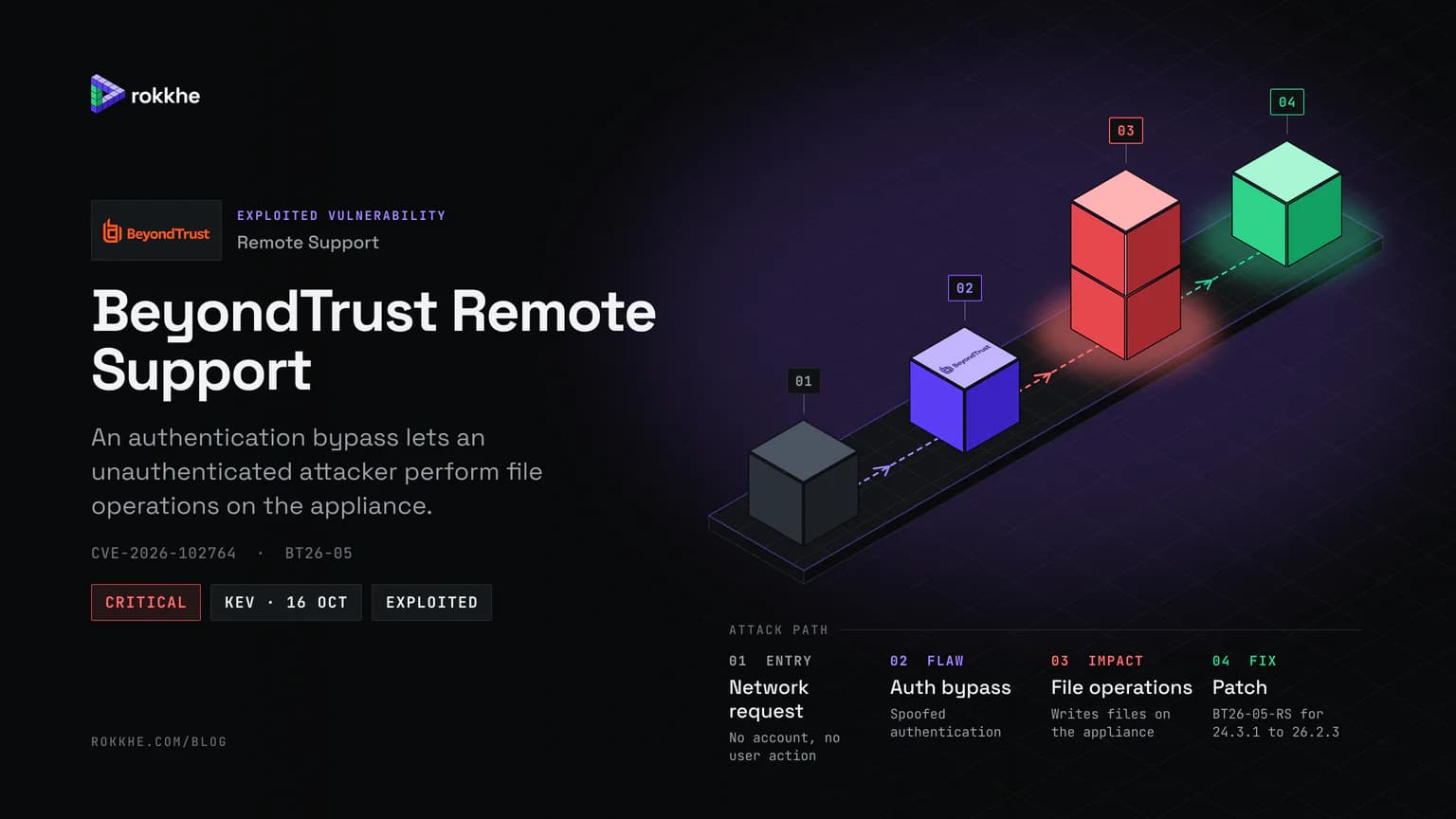
CVE-2026-102764 is an authentication bypass in BeyondTrust Remote Support that lets a remote, unauthenticated attacker perform file operations on the appliance. Mandiant attributes zero-day exploitation from late August 2026 to ARMORY CASTLE, and CISA added it to KEV on 16 October 2026. Versions 26.2.3 and earlier are affected. SaaS was patched by 9 October; self-hosted appliances need the BT26-05-RS patch, after upgrading to 24.3.1 or later if older.
The attack path
Four steps, from the way in to the fix.
A remote support appliance holds the credentials and session rights for every machine it reaches. CVE-2026-102764 let an attacker with no account write files to a BeyondTrust Remote Support appliance, and in the intrusion Mandiant documented, that became a web shell, root on the appliance and administrator access to the systems it brokers. Every version up to and including 26.2.3 is affected. The fix is a patch, BT26-05-RS, rather than a newer release.
The attacks came weeks before the fix. On 29 August 2026 an actor hit one BeyondTrust-hosted instance and one self-hosted appliance. BeyondTrust's sensors fired when the actor escalated privileges, but automated triage in its third-party detection platform closed the alerts as false positives; a threat hunt found the hosted instance on 28 September. BeyondTrust shipped the patch on 8 October and disclosed on 15 October with Mandiant. CISA added the CVE to its Known Exploited Vulnerabilities catalog the next day, with a 19 October deadline.
Who is affected
Advisory BT26-05 names Remote Support only. BeyondTrust's blog adds Privileged Remote Access (PRA) as a precaution:
| Product | Affected | Fixed |
|---|---|---|
| Remote Support, self-hosted | 24.3.1 to 26.2.3 | BT26-05-RS patch |
| Remote Support, self-hosted | Older than 24.3.1 | Upgrade to a supported version, then apply BT26-05-RS |
| Remote Support SaaS | Patched by BeyondTrust | All customers as of 9 October 2026 |
| PRA, self-hosted | Shares the code; no exploit path found | PRA patch released, not listed in the advisory |
| PRA SaaS | Patched by BeyondTrust | Automatically, per BeyondTrust's blog |
The vendor's CVSS vector describes a network attack needing no privileges or user interaction; beyond that, BeyondTrust says only that it works "under the right conditions". CISA's KEV entry names Remote Support alone.
How CVE-2026-102764 works
BeyondTrust says internal messaging components in Remote Support did not adequately check where the messages they received came from, so a spoofed message could make the appliance perform file operations. The CVE record classes it as CWE-290, authentication bypass by spoofing. BeyondTrust is withholding technical details while customers patch. The patch also closes other paths its variant analysis found.
Mandiant describes the result as arbitrary file upload. In its incident, POST requests to an unusual .php path were followed 11 minutes later by a web shell, SAWFLY, in the web root. From the unprivileged site account the actor reached root through a SUID copy of /bin/sh, kept root across reboots with a startup script, and tried to dump the credential vault. It then raised an administrator account's Jump Item and team roles, pulled documents from an internal endpoint through a support session, and tunneled traffic through BARECLAW.
Is it being exploited?
Yes. CISA added CVE-2026-102764 to KEV on 16 October 2026 with a 19 October due date and forensic triage required. It lists ransomware use as unknown.
- Actor. Google Threat Intelligence Group attributes the exploitation to ARMORY CASTLE, a suspected PRC-nexus espionage actor formerly tracked as UNC5221. BeyondTrust agrees with moderate to high confidence.
- Victims. BeyondTrust knows of two, the hosted and self-hosted cases, and as of 16 October had seen no actor activity since August.
- Outlook. Mandiant warns this actor has moved to broad exploitation after past disclosures. That is a forecast; we found no public report of post-disclosure exploitation as of 28 October.
Check your exposure
Confirm in the /appliance interface that BT26-05-RS is installed. Customers cannot audit the appliance's file system, Mandiant notes, so hunt in logs kept elsewhere:
# Reverse proxy, WAF or firewall logs: paths from Mandiant's report
grep -iE "app_84304470(%2E|\.)php|mangoapi\.php|/uidchanarge" proxy-access.log

# Appliance syslog exported from your SIEM: role changes to review
grep -i "user_changed" appliance-syslog.log | grep -i "jump_item_role"

# Successful console logins, to match against known administrators
grep -i "web/login" appliance-syslog.log | grep -i "success"
An empty result means little unless syslog was forwarded throughout the window; the actor deleted on-box logs.
Fix it
- SaaS: nothing to do on the appliance, though Mandiant says its credential and configuration review still applies.
- Self-hosted, 24.3.1 or later: apply BT26-05-RS from
/appliance. If it is not offered, open a BeyondTrust Support case citing BT26-05. - Self-hosted, older than 24.3.1: upgrade to a supported version, then patch.
- PRA, self-hosted: apply the PRA patch, confirming the package with BeyondTrust Support.
There is no workaround. Mandiant's compensating controls narrow exposure without replacing the patch: restrict /login and /appliance by IP, log full URIs at a reverse proxy, and set the default Jump Item role to No Access.
If you suspect compromise, Mandiant advises:
- Preserve evidence first: snapshot virtual appliances with memory, or ask BeyondTrust Support to preserve hardware.
- Block the appliance at the perimeter firewall, leaving its configuration intact.
- Rebuild from a clean, patched image, restore a pre-window configuration backup, and issue a new TLS certificate.
- Only then rotate credentials, including API secrets, directory bind accounts and anything typed into a session.
Detect attempts and compromise
Signals published by Mandiant and BeyondTrust:
- Request paths. POSTs to
/app_84304470%2Ephp, other unknown.phppaths, and WebSocket upgrades to/uidchanargefrom outside support ranges. - Web shell. SAWFLY,
mangoapi.php, SHA-256dc14e215269a93fdbc4c1a80b984c23faf7af0911c6dbb85309796a6f2ae95fb. It answers 404 unless a specific parameter is present, so probing it can look clean. - Host artifacts. A SUID
/usr/bin/dbus-authd,/home/bomgar/sbin/post_boot.d/zz-root-persist, aNOPASSWDline in/ns/config/sudoers.template, and BARECLAW at/tmp/ingredi_ws, SHA-2561f19b9a27d79c11bda00a1e8faf74a7fdd683d38ccef1b60df2fd0307e3aa462, behind a/uidchanargeroute in/ns/config/haproxy.conf. These need a forensic image. - Account changes.
user_changedevents raising Jump Item or team roles to Administrator, and unticketeduser_added,api_accountorsecurity_providerevents. - Logins.
/loginsuccesses from residential or commercial VPN addresses, and off-hours administrator logins. - Log gaps. A break in syslog forwarding bounded by one session, which Mandiant calls a strong sign of tampering.
Mandiant's post includes YARA rules for both tools; neither public post lists network indicators. If a signal fired, open a Sev 1 case citing BT26-05, rebuild as above, rotate every credential the appliance stored or injected, and review session reports: every endpoint the actor touched is in scope.
Beyond this patch
This is the fourth BeyondTrust remote access flaw added to CISA's KEV catalog since December 2024; the October KEV list shows how many edge products share the pattern. Treat remote support appliances as tier-zero: keep admin consoles off the internet, grant roles by policy, and send logs where root on the box cannot reach them. Treat an automated triage verdict as one input, not a reason to stop looking. Rokkhe's SOC pipeline shows how forwarded events become cases with the evidence kept.
Frequently asked questions
Am I affected if I use BeyondTrust Remote Support SaaS?
Not by the open vulnerability. BeyondTrust says the patch was applied to every Remote Support SaaS customer as of 9 October 2026, and no action is needed on the appliance. One BeyondTrust-hosted instance was compromised in August, before the fix existed, and Mandiant says its credential and configuration review steps still apply to SaaS tenants: check users, roles, API accounts and session reports against a known-good baseline.
Is BeyondTrust Privileged Remote Access affected?
BeyondTrust's advisory and CISA's KEV entry name only Remote Support. BeyondTrust's blog says its testing found no way to exploit the flaw in Privileged Remote Access, but PRA shares the affected code, so it released a PRA patch and asks self-hosted PRA customers to apply it immediately. PRA SaaS instances were patched automatically. The advisory does not name the PRA package, so confirm it with BeyondTrust Support.
Is there a workaround if I cannot patch?
No. BeyondTrust offers only the patch, and Mandiant says its compensating controls do not substitute for it. Those controls still narrow the exposure: limit /login and /appliance to trusted networks, leave only representative console, customer portal and Jump Client traffic reachable from the internet, log full request paths at a reverse proxy, and set the default Jump Item role to No Access in every group policy.
Is CVE-2026-102764 being exploited?
Yes. Mandiant attributes zero-day exploitation from late August 2026 to ARMORY CASTLE, a suspected PRC-nexus espionage actor formerly tracked as UNC5221. BeyondTrust knows of two victims, one hosted and one self-hosted, and as of 16 October had seen no actor activity since August. CISA added the CVE to KEV on 16 October 2026 with a 19 October deadline. Mandiant warns that broader exploitation may follow disclosure.
How do I detect a BeyondTrust Remote Support compromise?
Look off the appliance first, because the actor deleted local logs. Search reverse proxy and SIEM records for requests to unknown .php paths or /uidchanarge, user_changed events that raised Jump Item or team roles to Administrator, administrator logins from VPN or residential addresses, and breaks in syslog forwarding. Mandiant published hashes and YARA rules for its web shell and tunneler. Host artifacts need a forensic image.
Sources
- BeyondTrust — Security Advisory BT26-05 (CVE-2026-102764)
- BeyondTrust — ARMORY CASTLE and BT26-05: What Security Teams Need to Know
- CISA — Known Exploited Vulnerabilities catalog (JSON feed)
- CVE record — CVE-2026-102764 (BeyondTrust CNA data)
- NVD API — CVE-2026-102764
- Mandiant and Google Threat Intelligence Group — ARMORY CASTLE Exploits BeyondTrust
- Canadian Centre for Cyber Security — AL26-025
- Rapid7 — CVE-2026-102764: BeyondTrust Remote Support authentication bypass exploited in the wild
Published 28 October 2026 · By the Rokkhe research team