PolyShell CVE-2026-48356: exploited Adobe Commerce and Magento upload
An unauthenticated file upload in Adobe Commerce and Magento plants web shells and is in CISA KEV. Affected versions, the July patch and detection signals.
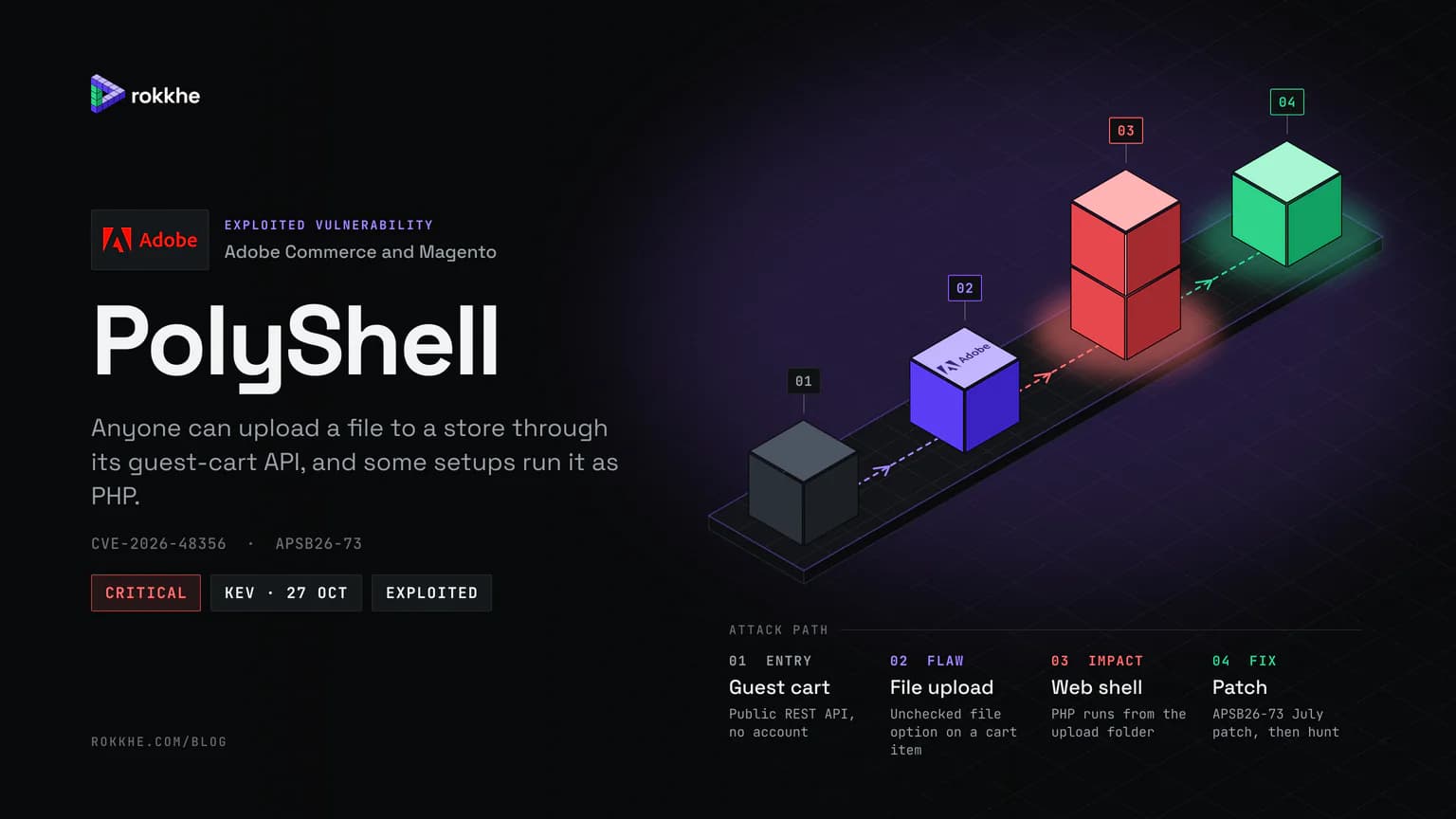
PolyShell, CVE-2026-48356, is an unrestricted file upload in Adobe Commerce, Magento Open Source and Commerce B2B: anyone can write a file to a store through the guest-cart REST API, and some web server setups then run it as PHP. Sansec reported mass exploitation from March 2026, and CISA added it to KEV on 27 October 2026. Apply Adobe's July 2026 isolated patch from APSB26-73, or the latest cloud patches.
The attack path
Four steps, from the way in to the fix.
PolyShell, tracked as CVE-2026-48356, needs no account, no admin access and no third-party extension, only a guest shopping cart. Magento's REST API lets an anonymous shopper attach a file to a cart item and writes it to disk with almost no checks. Whether it then runs as PHP, renders as a script or just sits there depends on the web server.
Sansec named the flaw and warned about it on 17 March 2026, when no patch existed for production releases. Attacks began on 19 March, and on 30 March Sansec counted 471 stores compromised in one hour. Adobe backported a fix to its supported release lines on 14 July in bulletin APSB26-73, rated priority 2. CISA added the CVE to its Known Exploited Vulnerabilities catalog on 27 October 2026, with a 10 November deadline for federal agencies.
Who is affected
Adobe Commerce (on-premises and on cloud infrastructure), Magento Open Source and Commerce B2B without the July 2026 patch:
| Release line | Affected | Fixed |
|---|---|---|
| 2.4.9 | 2.4.9 | 2.4.9-2026-jul |
| 2.4.8 | 2.4.8-p5 and earlier | 2.4.8-2026-jul |
| 2.4.7 | 2.4.7-p10 and earlier | 2.4.7-2026-jul |
| 2.4.6 | 2.4.6-p15 and earlier | 2.4.6-2026-jul |
| 2.4.5 (Commerce only) | 2.4.5-p17 and earlier | 2.4.5-2026-jul |
| 2.4.4 (Commerce only) | 2.4.4-p18 and earlier | 2.4.4-2026-jul |
| Commerce B2B | 1.5.3; 1.5.2-p5, 1.4.2-p10, 1.3.4-p17, 1.3.3-p18 and earlier | The matching 2026-jul patch |
The "2026-jul" fixes are isolated patch files, not Composer releases. Magento Open Source 2.4.5 and older get no patch; Sansec says the vulnerable code dates back to the first Magento 2 release. Sources disagree on 2.4.9: Sansec says the 12 May release carried the fix, but Adobe lists it as affected and patches it.
How PolyShell works
When a cart item carries a custom option of type "file", the REST API accepts an embedded file_info object with base64 data, a MIME type and a filename, and writes the file under pub/media/custom_options/quote/. Sansec found three checks missing: the option ID is never matched against the product's options, the upload runs even when the product has no file option, and no extension is refused. The only check, an image header test, passes a polyglot: a valid GIF or PNG that is also PHP.
The guest-cart item routes, POST /V1/guest-carts/:cartId/items and its PUT counterpart, need no credentials. Sansec says the GraphQL path is not vulnerable.
The outcome varies. Sansec lists code execution where the server runs PHP from that folder: stock nginx configuration on 2.0.0 to 2.2.x, nginx rules that pass every .php file to FastCGI, and Apache before 2.3.5 without php_flag engine 0. Some older or custom setups allow stored cross-site scripting instead. Where nothing executes, the file still waits on disk for a later configuration change.
Is it being exploited?
Yes. CISA added CVE-2026-48356 to KEV on 27 October "based on evidence of active exploitation". Most public detail comes from Sansec:
- Timeline. Probing from 16 March 2026, first attacks on 19 March, mass scanning from more than 50 IP addresses after 23 March.
- Payloads. Polyglot web shells, often named like
780index.php, that run PHP or shell commands behind a cookie or password. - Persistence. An
accesson.phpbackdoor copied under every writable top-level directory, and a JavaScript loader injected into CMS pages and static blocks. - Scale. 471 stores in one hour on 30 March. On 24 October Sansec found the same operator's loader on a new domain,
deepveindrilling.com, in 83 stores, most of them earlier victims.
Sansec also called PolyShell the likely entry point for a WebRTC payment skimmer it found in March, an assessment rather than a confirmed route. Adobe's bulletin, last updated on 11 August, still says Adobe is not aware of exploits in the wild.
Check your exposure
Run these from the Magento root on each web server:
# Installed release
php bin/magento --version

# Anything in the upload folder besides .htaccess deserves a look
find pub/media/custom_options/ -type f ! -name '.htaccess'

# The backdoor Sansec found sprayed across writable folders
find . -name 'accesson.php' -type f

# Requests for uploaded files or the backdoor (adjust the log path)
grep -E "custom_options/|accesson\.php" /var/log/nginx/access.log
A version string cannot show an isolated patch. After the July CE patch, Adobe's Commerce Version Tool (php vendor/bin/patch-status) reports each CVE as protected or vulnerable, writing cache and log files under var/.
Fix it
- Move to the newest patch release in your line: 2.4.8-p5, 2.4.7-p10, 2.4.6-p15, 2.4.5-p17 or 2.4.4-p18. The 2.4.9 patch applies to 2.4.9 itself.
- Download the July isolated patch for that release from Adobe's KA-37421 article. Apply the CE file first, then EE and B2B if you run them, each matching your installed version.
- On-premises, apply each file with
patch -p1and refresh the cache. On cloud infrastructure, the latest Magento Cloud Patches update already includes the fix; adding the isolated patch on top can break the install. - Confirm with the Commerce Version Tool. Monthly patches are non-cumulative and go on in sequence; two later Commerce flaws, CVE-2026-75650 and CVE-2026-71362, are also in KEV.
As a stopgap, Sansec advises denying web access to that folder with an nginx rule placed before any .php handler, or on Apache confirming that its .htaccess disables PHP. Akamai shipped a WAF rule on 27 March.
Detect attempts and compromise
Sansec has published these signals:
- Uploaded files. Any
.php,.phtmlor.pharfile inpub/media/custom_options/. - Backdoors.
accesson.phpanywhere in the document root. It prints the beacon8194460on every request. - CMS content. Static blocks or pages containing
fpCode,se_referrerorlocalStorage.getItem, or loadinglanhd6549tdhse[.]top,additionalver[.]com,deepveindrilling[.]com,jslibrary[.]netorcanevaslab[.]com. Theupdate_timecolumn ofcms_blockshows the latest write. - Accounts. Admin users you do not recognize. Sansec found a rogue admin account and a GSocket backdoor on a fully patched store that still received the loader in October.
If any fired, treat the server as compromised: the attacker ran code as the web server user and could write to your database, which deleting the script does not undo. Clean up, then change the database, admin and API integration passwords.
Beyond this patch
PolyShell was public for four months before Adobe backported a fix, and reached KEV seven months after attacks began. A priority rating and a "not aware of exploits" line are inputs, not verdicts. After patching, look for what the bug already left behind, and confirm the fix with evidence, not a version string; how a retest verifies a fix explains Rokkhe's approach for findings it has reproduced.
Frequently asked questions
Am I affected if my web server blocks PHP in the upload folder?
Yes, until you patch. Blocking execution in pub/media/custom_options/ stops an uploaded web shell from running, but the upload still succeeds and the file stays on disk. Sansec warns that a later configuration change, server migration or web server swap could expose it, and some setups allow stored cross-site scripting instead. Apply Adobe's July 2026 patch from APSB26-73 and check that folder for files you did not expect.
Is Adobe Commerce on cloud infrastructure affected?
Yes. Adobe's release notes for APSB26-73 list Adobe Commerce on cloud infrastructure alongside on-premises Adobe Commerce and Magento Open Source. Adobe says the latest Magento Cloud Patches update resolves the issue, and warns that applying the isolated patch on top of a cloud-patches update that already contains the fix can cause installation failures. Cloud merchants can also add the patch file to the m2-hotfixes directory and deploy.
Is there a workaround if I cannot patch today?
Not a complete one. Sansec advises denying all web access to pub/media/custom_options/ with an nginx rule placed before any PHP handler, or confirming on Apache that the folder's .htaccess disables PHP. That stops uploaded files from running but not from arriving. Sansec says only a web application firewall rule that blocks the API call itself stops the upload; Akamai added one for its customers on 27 March 2026.
Is CVE-2026-48356 being exploited?
Yes. CISA added it to the Known Exploited Vulnerabilities catalog on 27 October 2026, with a 10 November deadline for federal agencies. Sansec saw the first attacks on 19 March 2026 and 471 stores compromised in one hour on 30 March, with web shells, backdoors and JavaScript loaders in CMS blocks. Adobe's bulletin, last updated on 11 August, still says Adobe is not aware of exploits in the wild.
How do I check whether my store was compromised?
Look for any .php, .phtml or .phar file in pub/media/custom_options/, and for accesson.php anywhere in the document root. Search the cms_block and cms_page tables for fpCode, se_referrer or localStorage.getItem, and for the loader domains Sansec published. Review admin users you do not recognize. If anything turns up, clean the store, then change the database, admin and API integration passwords, as Sansec advises.
Sources
- Adobe — Security update available for Adobe Commerce (APSB26-73)
- Adobe — Security update available for Adobe Commerce - APSB26-73 (KA-37421, isolated patches)
- CISA — Adds Two Known Exploited Vulnerabilities to Catalog (27 Oct 2026)
- CISA — Known Exploited Vulnerabilities catalog (JSON feed)
- CVE record — CVE-2026-48356 (Adobe CNA data)
- NVD API — CVE-2026-48356
- Adobe — Commerce Version Tool: generate a patch-status report
- Adobe — How to apply a composer patch provided by Adobe
- Sansec — PolyShell: unrestricted file upload in Magento and Adobe Commerce
- Sansec — Mass PolyShell attack wave hits 471 stores in one hour
- Sansec — deepveindrilling.com: Magento CMS block loader hits 953 stores
- Sansec — Novel WebRTC skimmer bypasses security controls
- Akamai — Magento PolyShell analysis and WAF rule (27 Mar 2026)
Published 28 October 2026 · By the Rokkhe research team