php2shell: the PHP RCE pair CVE-2026-109618 and CVE-2026-109619
Two PHP flaws let an unauthenticated request run code on mod_php and some PHP-FPM setups. CISA lists both as exploited. Versions, detection and fixes.
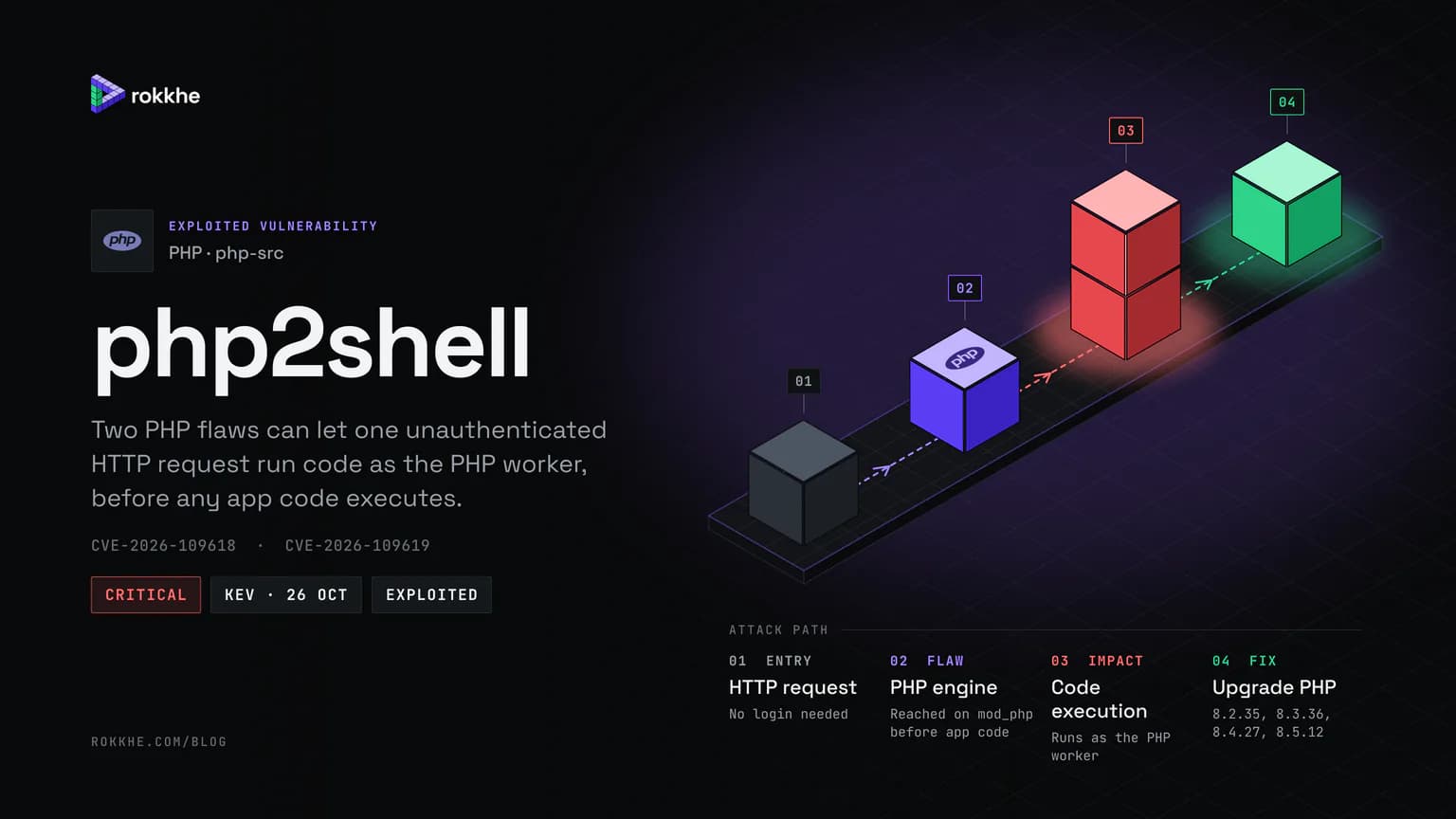
php2shell is a pair of PHP vulnerabilities, CVE-2026-109618 and CVE-2026-109619, that can let an unauthenticated HTTP request run code as the PHP worker, on mod_php before any application code executes. CISA added both to its Known Exploited Vulnerabilities catalog on 26 October 2026. Upgrade to PHP 8.2.35, 8.3.36, 8.4.27 or 8.5.12; PHP 8.1 and older get no upstream release.
The attack path
Four steps, from the way in to the fix.
Most remote code execution bugs live in an application. php2shell lives underneath them, in the code PHP runs to prepare a request before your application sees it. That is what made the October disclosure unusual: on a mod_php server, an attacker needs no account, no vulnerable plugin and no route of their own choosing. They need PHP to start parsing what they sent.
The two CVEs were meant to ship quietly. Both identifiers leaked on 20 October 2026, a day before the coordinated release, which PHP then published at 14:00 UTC on 21 October. CISA issued an alert the same day and added both bugs to its Known Exploited Vulnerabilities catalog five days later, giving federal agencies until 29 October to patch.
Who is affected
Every supported PHP branch before these releases:
| Branch | Fixed in |
|---|---|
| 8.5 | 8.5.12 |
| 8.4 | 8.4.27 |
| 8.3 | 8.3.36 |
| 8.2 | 8.2.35 |
| 8.6 (pre-release) | RC4 |
| 8.1, 8.0, 7.4 | No upstream release; source backport branches only |
How exposed a given server is depends on how PHP is attached to the web server. mod_php (PHP loaded inside Apache) is the confirmed path for both bugs. PHP-FPM is conditional: one confirmed route for the second bug runs through session.upload_progress, which is on by default, and the sources disagree about how far the first bug reaches on FPM. Until you have upgraded, plan as if FPM is exposed too.
How php2shell works
The name covers two separate memory-safety bugs that end in the same place: attacker-controlled data treated as live memory inside the PHP worker.
CVE-2026-109618: running out of memory at the wrong moment
When PHP runs out of memory, it does not unwind politely. It jumps straight out of whatever it was doing. If that happens while the request is still being assembled, the half-built request data is left behind, and the end-of-request cleanup later operates on it as if it were whole.
The attacker's job is to force that out-of-memory condition without tripping the limits meant to prevent it. The advisory describes the quirks that make it possible in multipart form handling: requests with no usable Content-Length, an unlimited number of headers per part, empty file fields and deeply nested field names. On mod_php, PHP demonstrated code execution with default limits, before any application code runs.
CVE-2026-109619: state that outlives its request
A long-lived PHP worker serves many requests. Some of its global pointers refer to memory that belongs to one request. Normally those pointers are reset at the end of the request. A fatal error, a timeout or an out-of-memory event can skip that reset, the memory is freed, and the next request served by the same worker uses the stale pointer before startup reinitializes it.
The routes PHP confirmed are mod_php with .htaccess php_value directives that raise a warning before startup, PHP 8.5's fatal_error_backtraces, and session.upload_progress.
Is it being exploited?
CISA says yes, and the KEV listing is what drives most patch deadlines. The public record is more mixed, and it is worth knowing why:
- watchTowr reported honeypot exploitation on 21 October but has not published the evidence.
- Huntress saw no exploitation across its customers that day.
- Unit 42 linked an incident to php2shell, then withdrew that attribution on 25 October.
None of that changes the decision. The fix is a routine point release, and the preconditions on mod_php are minimal.
Check your exposure
Find the version and the SAPI each site actually uses, not just the CLI on the host:
# The PHP the web server runs may differ from the CLI.
php -r 'echo PHP_VERSION, " ", PHP_SAPI, PHP_EOL;'

# Is PHP loaded into Apache (mod_php)?
apachectl -M 2>/dev/null | grep -i php

# Which FPM pools are running, and as whom?
ps -eo user,pid,cmd | grep '[p]hp-fpm'
For each site, a phpinfo() page behind authentication, or your configuration management inventory, tells you the server API and loaded .ini files.
Fix it
Upgrade to the fixed release for your branch and restart every PHP process: Apache for mod_php, each FPM pool for FPM. Container images need a rebuild, not just a restart.
If you need hours rather than minutes, PHP's advisories list configuration that lowers the risk. Set it in server configuration, because ini_set() from application code runs too late to help:
; Removes one confirmed route for CVE-2026-109619.
session.upload_progress.enabled = 0

; PHP 8.5 only.
fatal_error_backtraces = 0

; Keep request bodies small (8M is PHP's default; go lower where you can),
; and enforce multipart limits at the proxy as well.
post_max_size = 8M
PHP's advisory also suggests setting memory_limit = -1 with php_admin_value, and warns against the opposite instinct: capping memory with RLIMIT_AS or RLIMIT_DATA triggers the bug rather than containing it.
Detect attempts and compromise
Published guidance points at three signals:
- Process trees. A PHP worker that starts
sh,curl,wgetornc, or a command line containing/dev/tcp/ormkfifo. This is the highest-value alert, because it fires on success whatever the delivery route. - Request shape. Very large or deeply nested multipart requests, especially to endpoints that never accept uploads.
- Worker health. Bursts of worker crashes or memory-limit errors in the PHP and web server logs.
CISA has published a Sigma rule for php2shell in its SIGMA_Rules repository, and network vendors have shipped signatures. If any of these fired before you patched, treat the host as compromised: the attacker ran as the web server user and could read everything that user can.
Beyond this patch
php2shell is a reminder that "unauthenticated" and "no application bug required" can coexist. The durable lessons are inventory and verification: know which SAPI every site runs, and confirm a fix with evidence rather than a version string. Rokkhe's retests do the second part for findings it has reproduced; how a retest verifies a fix explains what that evidence looks like.
Frequently asked questions
Am I affected if I run PHP-FPM behind nginx?
Treat it as affected until you have upgraded. The mod_php path is confirmed for both bugs. For CVE-2026-109618 on FPM the sources disagree: PHP's advisory says no full exploit has been shown, while the PHP Foundation says code execution was confirmed through application code paths. One confirmed CVE-2026-109619 route, session.upload_progress, is enabled by default and was tested against FPM.
Is there a workaround if I cannot upgrade today?
Not a complete one. PHP says only updating fixes the bugs; configuration lowers the risk. Disable session.upload_progress in server configuration, turn off fatal_error_backtraces on PHP 8.5, keep post_max_size low and enforce multipart limits at the reverse proxy. Do not cap memory with RLIMIT_AS or RLIMIT_DATA, which triggers the bug. CISA advises taking unpatchable systems offline.
Is php2shell being exploited in the wild?
CISA lists both CVEs as known exploited, with a federal remediation deadline of 29 October 2026. The public evidence is thinner than that listing suggests: watchTowr reported honeypot hits on 21 October without publishing them, Huntress saw no exploitation across its customers that day, and Unit 42 withdrew an incident attribution on 25 October.
What about PHP 8.1, 8.0 and 7.4?
They receive no upstream release. PHP publishes source backport branches for 7.4, 8.0 and 8.1, and some Linux distributions ship backported packages, so check your distribution's advisory. CISA's guidance for systems that cannot be patched, including PHP 8.1 and older, is to take them offline.
How do I spot an attempt or a compromise?
Watch for PHP workers starting shells or download tools such as sh, curl, wget or nc, command lines containing /dev/tcp/ or mkfifo, unusually large or deeply nested multipart requests, and worker crashes or memory-limit errors. CISA has published a Sigma rule for php2shell in its SIGMA_Rules repository.
Sources
- CISA — Critical Vulnerabilities in PHP Require Immediate Patching (21 Oct 2026)
- CISA — Adds Two Known Exploited Vulnerabilities to Catalog (26 Oct 2026)
- PHP security advisory GHSA-w8hw-w9fx-j79w (CVE-2026-109618)
- PHP security advisory GHSA-6wmf-4rv5-p3rp (CVE-2026-109619)
- php.net — 2026 news archive (fixed releases and backports)
- NVD — CVE-2026-109618
- NVD — CVE-2026-109619
- Huntress — php2shell: leaked critical PHP vulnerabilities
- watchTowr — PHP remote code execution (php2shell)
- Unit 42 — CVE-2026-109618 and CVE-2026-109619
- CISA SIGMA_Rules repository
Published 28 October 2026 · By the Rokkhe research team