Cisco Secure Email Gateway CVE-2026-76519: root from one email
A crafted attachment can give root on Cisco Secure Email Gateway when File Reputation is on. CISA lists it as exploited. Conditions, fixes and checks.
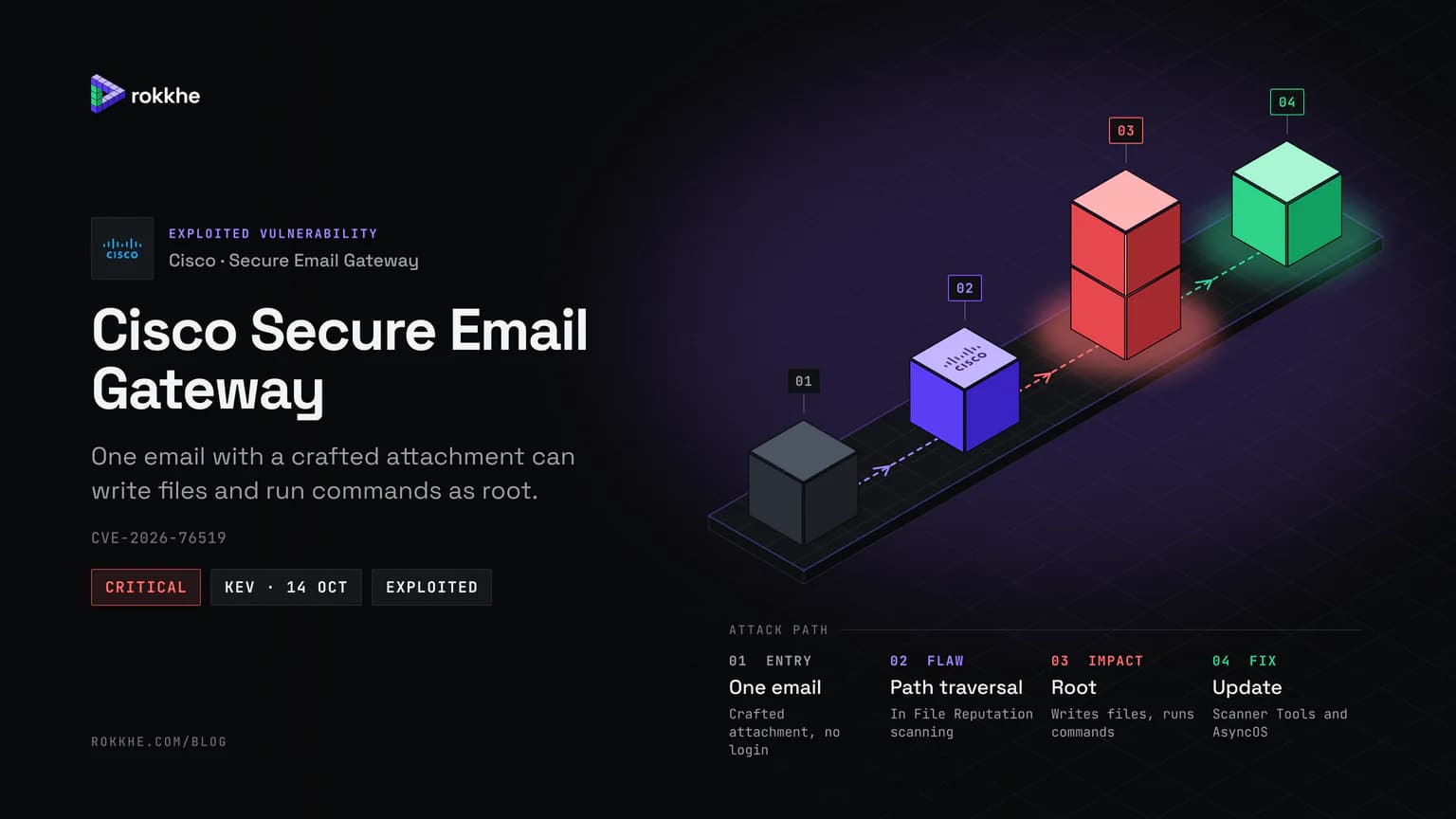
CVE-2026-76519 is a path traversal flaw in the File Reputation feature of Cisco Secure Email Gateway. An unauthenticated attacker can send an email with a crafted attachment and write files and run commands as root. Only gateways with File Reputation on in a mail policy and Content Scanner Tools older than 25.3.0.5525 are vulnerable. Cisco and CISA report active exploitation. Update Content Scanner Tools and move to AsyncOS 15.5.5-014 or 16.5.0-780.
The attack path
Four steps, from the way in to the fix.
Most appliance bugs need an exposed admin page or a login. CVE-2026-76519 needs an email. An unauthenticated attacker sends a message with a crafted attachment through a Cisco Secure Email Gateway, and the gateway's own malware scanning ends up writing attacker-chosen files and running commands as root. The catch is that only gateways with one feature on, and one component out of date, are vulnerable.
Cisco published the advisory on 14 October 2026, saying its PSIRT had become aware of active exploitation that month. CISA added the CVE to its Known Exploited Vulnerabilities catalog the same day, with a 17 October deadline. The fixed AsyncOS builds are the same ones Cisco shipped in a September hardening release, and how the two advisories relate is still not fully confirmed by Cisco.
Who is affected
Physical and virtual Cisco Secure Email Gateway appliances, when both conditions below hold. Cisco says Secure Email and Web Manager and Secure Web Appliance are not affected.
| Component | Vulnerable | Fixed in |
|---|---|---|
| Content Scanner Tools | Earlier than 25.3.0.5525 | 25.3.0.5525 and later |
| AsyncOS 15.5 | Earlier than the fix | 15.5.5-014 |
| AsyncOS 16.0 | All | Migrate to a fixed release |
| AsyncOS 16.5 | Earlier than the fix | 16.5.0-780 |
The two conditions are:
- File Reputation (part of Advanced Malware Protection) is enabled and assigned to at least one incoming or outgoing mail policy.
- Content Scanner Tools is older than 25.3.0.5525.
Cisco recommends that anything older than AsyncOS 16.5 migrate to 16.5.0-780. It also distributes the fix to all licensed, supported AsyncOS releases through the Content Scanner Tools package.
How CVE-2026-76519 works
When File Reputation is on, the gateway processes attachments for reputation lookups. Cisco says it handles those attachments improperly: a relative path traversal (CWE-23) lets a crafted attachment write files outside the place they belong. Arbitrary file write as root becomes command execution as root on the underlying operating system.
The attacker needs no account and no access to the management interface; mail delivery is the attack path. Cisco scores it 9.8 under CVSS 3.1, and found it during internal security scanning. Cisco has not published deeper technical detail.
The September hardening release
On 14 September 2026, Cisco published a hardening advisory for Secure Email Gateway and Secure Email and Web Manager that fixed five CVEs, including CVE-2026-76440, a CWE-23 path traversal scored 9.8. Its fixed gateway builds are the same 15.5.5-014 and 16.5.0-780.
On 14 October, Cisco updated that advisory to say two of its issues are actively exploited, one path traversal and one injection flaw, and linked the CVE-2026-76519 advisory. SecurityWeek reports that the CVE-2026-76519 fix shipped in September under CVE-2026-76440. Cisco's own text does not say that, so treat the renaming as unverified. In practice, a gateway upgraded to those builds in September runs a fixed AsyncOS release.
Is it being exploited?
Yes. Cisco PSIRT says it became aware of active exploitation in October 2026. CISA listed the CVE in KEV on 14 October with a 17 October due date and marked forensic triage as required under BOD 26-04. Ransomware use is listed as unknown.
What is not known: who is behind the attacks, when they began and how many gateways were hit. Cisco has contacted Secure Email Cloud customers whose systems showed indicators of compromise. SecurityWeek calls this the second Secure Email Gateway flaw exploited since mid-September, after CVE-2026-76461, which BleepingComputer describes as a separate bug in AsyncOS email parsing.
Check your exposure
From the gateway CLI, on every cluster member:
# AsyncOS release.
version

# Content Scanner Tools version; vulnerable if older than 25.3.0.5525.
contentscannerstatus

# Cisco's compromise check.
grep "System Security" system_logs
Then check File Reputation in the web interface: Mail Policies, Incoming Mail Policies (and Outgoing), Advanced Malware Protection, and look for Enable File Reputation on each policy.
Fix it
Update Content Scanner Tools first. Cisco says it needs no software upgrade or restart: run contentscannerupdate, or turn on automatic updates under Security Services, Service Updates. Then upgrade AsyncOS to 15.5.5-014 or 16.5.0-780. Cisco says no workarounds exist.
If a gateway shows signs of compromise, Cisco's recovery steps depend on the platform:
- Virtual appliances. Preserve forensic data first, because upgrading a compromised instance destroys it. Deploy a new VM on a fixed release, rebuild the configuration without importing old configuration files, and renew all credentials and cryptographic material.
- Clusters. Restore every member, since cluster SSH keys may have been exposed.
- Physical appliances. Contact Cisco TAC and enable remote access for the investigation.
Detect attempts and compromise
Cisco's check prints one of three results:
- Suspected compromise indicator was found. Treat the gateway as compromised, contact TAC and follow the recovery steps above.
- Security scan did not complete. Contact TAC.
- No compromise indicator was found. Upgrade if you have not already.
Root access lets an attacker hide evidence on the device, so Cisco also recommends looking outside it: firewall and network logs showing unexpected uploads from the gateway to external IPs, or downloads from malicious ones.
Beyond this patch
Security appliances parse hostile input for a living, which makes their scanning engines part of the attack surface. Track feature-level conditions and content packages as carefully as firmware versions, and send appliance logs somewhere an attacker with root cannot edit. The SOC pipeline docs describe how Rokkhe handles forwarded alerts.
Frequently asked questions
Am I affected if File Reputation is turned off?
According to Cisco, no. A gateway is vulnerable only when File Reputation, part of Advanced Malware Protection, is enabled and assigned to a mail policy and Content Scanner Tools is older than 25.3.0.5525. Check every incoming and outgoing mail policy, because one policy with File Reputation on is enough. Updating Content Scanner Tools is still the safer path.
Is there a workaround for CVE-2026-76519?
Cisco says no workaround exists. The quickest fix is updating Content Scanner Tools to 25.3.0.5525 or later, which Cisco says needs no software upgrade or restart: run contentscannerupdate or enable automatic service updates. Cisco also lists fixed AsyncOS releases, 15.5.5-014 and 16.5.0-780, and recommends that anything older than 16.5 move to 16.5.0-780.
Is CVE-2026-76519 being exploited?
Yes. Cisco PSIRT became aware of active exploitation in October 2026, and CISA added the CVE to its Known Exploited Vulnerabilities catalog on 14 October 2026 with a 17 October deadline and a forensic triage requirement. Cisco has not named an attacker, said when attacks began or how many appliances were hit.
How do I check a Cisco Secure Email Gateway for compromise?
Run grep "System Security" system_logs in the CLI on every cluster member. The result says a compromise indicator was found, none was found, or the scan did not complete. Contact Cisco TAC for the first and third. Because root access lets an attacker hide evidence, also review firewall logs for unexpected uploads to or downloads from external IPs.
Is CVE-2026-76519 the same as CVE-2026-76440?
Not confirmed by Cisco. SecurityWeek reports that the fix shipped on 14 September 2026 under CVE-2026-76440 in Cisco's hardening release. That advisory has the same fixed AsyncOS builds and now links the CVE-2026-76519 advisory as its exploited path traversal issue, but Cisco's text does not name CVE-2026-76519 as a renamed CVE-2026-76440.
Sources
- Cisco — Secure Email Gateway Arbitrary File Write Vulnerability (cisco-sa-esa-afw-zqYJkjxp)
- Cisco — Secure Email Gateway and Secure Email and Web Manager Security Hardening Release: September 2026
- CISA — Known Exploited Vulnerabilities Catalog: CVE-2026-76519
- CISA — Adds Four Known Exploited Vulnerabilities to Catalog (14 Oct 2026)
- NVD — CVE-2026-76519
- SecurityWeek — Cisco Warns of Exploited Secure Email Gateway Vulnerability
- BleepingComputer — Cisco patches new Secure Email Gateway zero-day exploited in attacks
Published 28 October 2026 · By the Rokkhe research team