FortiMail CVE-2026-104286: exploited unauthenticated file write
A FortiMail path traversal lets unauthenticated attackers write files through the IBE feature. It is exploited. Affected versions, workarounds and IOCs.
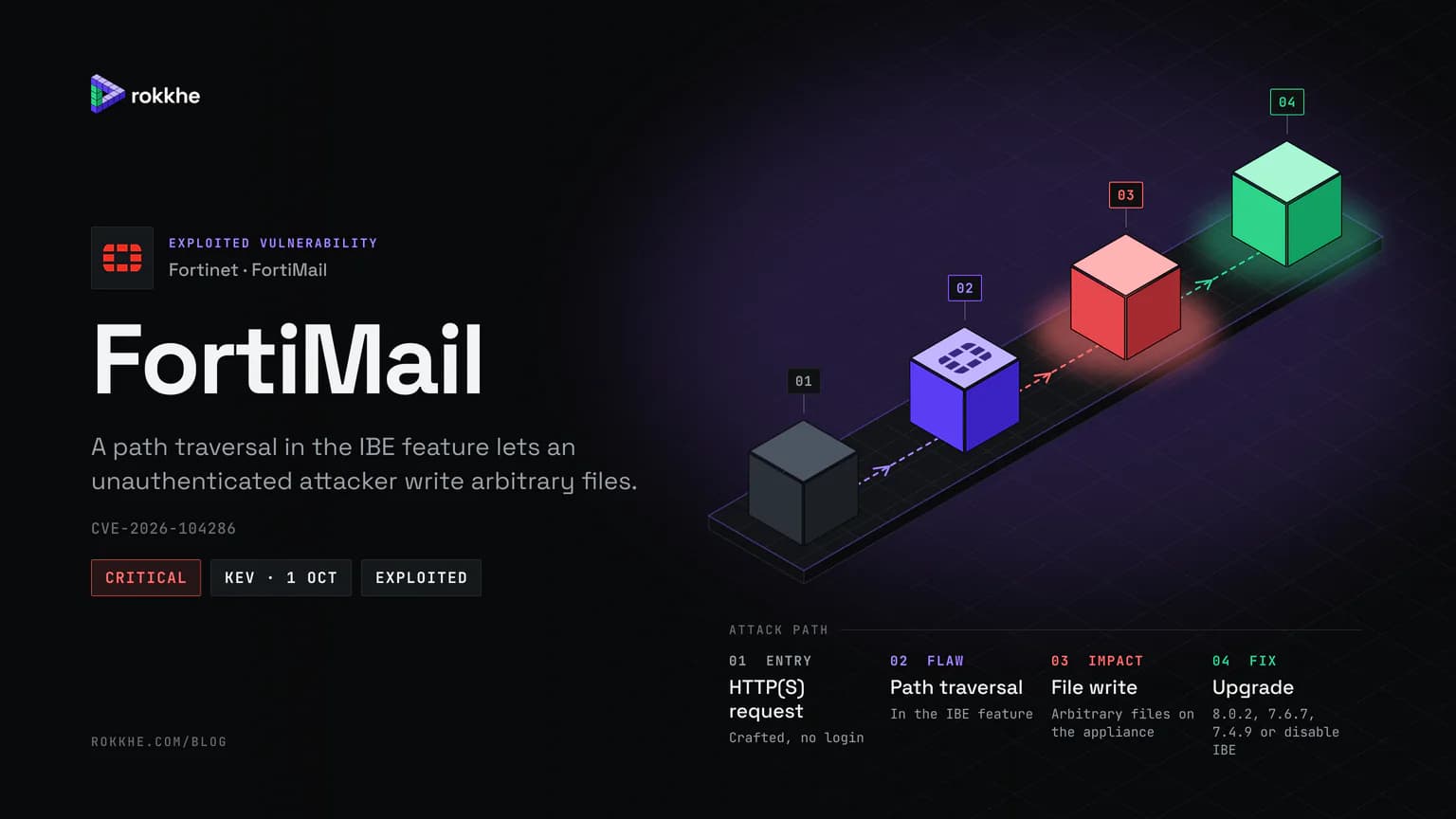
CVE-2026-104286 is a path traversal flaw in Fortinet FortiMail that lets an unauthenticated attacker write arbitrary files through crafted HTTP or HTTPS requests to the IBE feature. FortiMail 7.2 through 8.0.1 is affected. Fortinet reports exploitation, and CISA added it to the KEV catalog on 1 October 2026. Upgrade to 8.0.2, 7.6.7 or 7.4.9; 7.2 must move to 7.4. Otherwise disable IBE.
The attack path
Four steps, from the way in to the fix.
FortiMail sits at the edge of the mail flow, holding messages, archives and the credentials that connect it to the rest of the network. CVE-2026-104286 lets anyone who can reach its web interface write files onto the appliance without logging in, through the Identity-Based Encryption (IBE) feature. Fortinet rates the impact as running unauthorized code or commands.
Fortinet found the bug internally and published advisory FG-IR-26-175 on 1 October 2026 with a note that it was already exploited in the wild. CISA added it to its Known Exploited Vulnerabilities catalog the same day and gave federal agencies until 4 October. At first Fortinet pointed customers to a workaround; the advisory now lists fixed releases for three of four branches.
Who is affected
| Branch | Affected | Fixed in |
|---|---|---|
| FortiMail 8.0 | 8.0.0 through 8.0.1 | 8.0.2 |
| FortiMail 7.6 | 7.6.0 through 7.6.6 | 7.6.7 |
| FortiMail 7.4 | 7.4.0 through 7.4.8 | 7.4.9 |
| FortiMail 7.2 | 7.2.0 through 7.2.9 | No fix; move to 7.4 or later |
| FortiMail Cloud | — | Fixed by Fortinet on 5 October 2026 |
Exposure follows the IBE service and the webmail interface. Fortinet's workarounds disable IBE, take the webmail interface off the internet, or block POST requests to /ibe that carry ../ at a web application firewall. That points to the IBE web endpoint as the way in. An appliance whose webmail interface is reachable from the internet with IBE enabled is the case to fix first.
How the FortiMail file write works
Fortinet classifies the bug as path traversal (CWE-22) combined with improper handling of NULL bytes (CWE-158). In plain terms, the appliance builds a file path from part of an unauthenticated HTTP or HTTPS request without stopping ../ sequences or NULL characters. The attacker can then write a file outside the directory it was meant for.
Writing a file in the right place is often enough to run code, and Fortinet lists the impact as executing unauthorized code or commands. watchTowr told Cybersecurity Dive the bug is "trivial to exploit." Fortinet scored it 9.8 under CVSS 3.1: network attack, low complexity, no privileges, no user interaction.
Fortinet has not published the vulnerable parameter or the files an attacker targets. NVD lists only CWE-22, while Fortinet and CISA list both weaknesses.
Is it being exploited?
Yes. Fortinet's advisory reports exploitation in the wild, CISA listed it in KEV on 1 October with a due date of 4 October, and CISA's assessment records active exploitation that can be automated with total technical impact. No threat actor has been named, and Fortinet has not said how many customers were hit.
Fortinet has not said when exploitation began. One detail is worth noting with care: some log samples in Fortinet's published indicator bundle are timestamped 20 July 2026. That suggests at least one compromise more than two months before disclosure, but Fortinet has not stated a start date, and a single sample timestamp does not establish one.
Exactly when each fixed build shipped is also unconfirmed. The advisory's timeline records a solution update on 5 October but no per-build release dates, and Cybersecurity Dive reported on 2 October that Fortinet had not given a patch date.
Check your exposure
Confirm the firmware version and whether IBE is enabled, from the FortiMail CLI:
get system status
show system encryption ibe
Then check whether the webmail interface answers from the internet, using an external scan or your firewall rules, and search your syslog archive for Fortinet's indicators:
grep -rE '79\.141\.169\.187|45\.129\.0\.192|archive234|logged out from \(null\)' /path/to/fortimail-logs/Fix it
Upgrade to 8.0.2, 7.6.7 or 7.4.9 or later. On 7.2, plan the move to the 7.4 branch. FortiMail Cloud customers need do nothing. Upgrading closes the hole but removes nothing an attacker left behind, so check for compromise as well.
If you cannot upgrade yet, Fortinet's workaround is to turn off IBE, in the GUI under Encryption, IBE, by switching IBE Service off, or in the CLI:
config system encryption ibe
    set status disable
end
Check whether you rely on IBE for encrypted mail before you change it. Fortinet's alternatives are to block internet access to the webmail interface, or allow it only from trusted private networks, or to have a WAF in front of FortiMail block POST requests to /ibe that contain ../.
Detect attempts and compromise
Fortinet published these indicators in the advisory and its STIX bundle:
- IP addresses.
79[.]141.169.187and45[.]129.0.192. - Root cron job. A system event showing cron running
/bin/shas root to write a file under/migadmin/www/named.session-plus a hex string. In the sample, the job saves the output of the CLIshowcommand there, exposing the configuration over the web, and deletes it a day later. - Rogue archive account. A config event adding an archive account such as
archive234that ships archives to a remote server at79.141.169.187. - Odd admin events. An admin logout from
(null). - IBE errors. IBE decrypter errors reporting invalid Base64 with character
0x2a, and failed-login messages for an internal user named*at your mail domain. - Files. Eight file hashes, with notes pointing to an
/etc/ld.so.preloadentry loading/data/lib/liblog.soand an altered/data/etc/httpd.conf.
If any of these appear, treat the appliance as compromised: remove unknown archive accounts, cron entries and preloaded libraries, rotate credentials stored in or reachable from its configuration, and review which mail archives left the device. Consider rebuilding from known-good firmware with Fortinet support.
Beyond this patch
Mail gateways hold some of the most sensitive data in an organization and sit on the internet by design. Keep management and webmail interfaces off the public internet unless a feature truly needs them, turn off features you do not use, and forward appliance logs off the box so evidence survives a compromise.
Frequently asked questions
Am I affected if I run FortiMail 7.2?
Yes. Every 7.2 release from 7.2.0 through 7.2.9 is affected, and Fortinet has not issued a fixed 7.2 build. Its remedy is to upgrade to the 7.4 branch, where 7.4.9 and later are fixed. Until you can upgrade, apply Fortinet's workaround: disable the IBE service, or remove internet access to the webmail interface.
Is there a workaround for CVE-2026-104286?
Yes. Fortinet's main workaround is to turn off Identity-Based Encryption, in the GUI under Encryption, IBE, or with the CLI command set status disable under config system encryption ibe. Alternatives are blocking internet access to the webmail interface, allowing it only from trusted private networks, or having a WAF block POST requests to /ibe that contain ../.
Is CVE-2026-104286 being exploited?
Yes. Fortinet's advisory, published 1 October 2026, reports exploitation in the wild, and CISA added the CVE to its Known Exploited Vulnerabilities catalog that day with a 4 October federal deadline. No threat actor has been named. Fortinet has not said when attacks began, though some log samples in its indicator bundle are dated 20 July 2026.
How do I detect a FortiMail compromise from CVE-2026-104286?
Search FortiMail logs for Fortinet's indicators: the IP addresses 79.141.169.187 and 45.129.0.192, root cron jobs writing hidden .session files under /migadmin/www, a new archive account such as archive234 sending data to a remote server, admin logouts from (null), and IBE Base64 decoding errors. Fortinet's STIX bundle also lists eight file hashes.
Do FortiMail Cloud customers need to do anything?
No. Fortinet says it remediated FortiMail Cloud on 5 October 2026 by moving all instances to firmware 7.6.7 or 8.0.2, so Cloud customers need take no action for the fix itself. Reviewing logs for Fortinet's published indicators is still worthwhile, because the bug was exploited before disclosure.
Sources
- Fortinet PSIRT — FG-IR-26-175 (CVE-2026-104286)
- Fortinet — FG-IR-26-175 CSAF record (CVSS vector, dates)
- Fortinet — FG-IR-26-175 STIX indicator bundle
- CISA — Known Exploited Vulnerabilities catalog (JSON feed)
- NVD — CVE-2026-104286 (API record)
- Cybersecurity Dive — Fortinet warns that critical flaw in FortiMail is facing exploitation
Published 28 October 2026 · By the Rokkhe research team