Citrix NetScaler zero-days CVE-2026-88771 and CVE-2026-88772
Exploited NetScaler ADC and Gateway flaws allow unauthenticated code execution, and a third, CVE-2026-88779, needs later builds. Versions, IOCs and recovery.
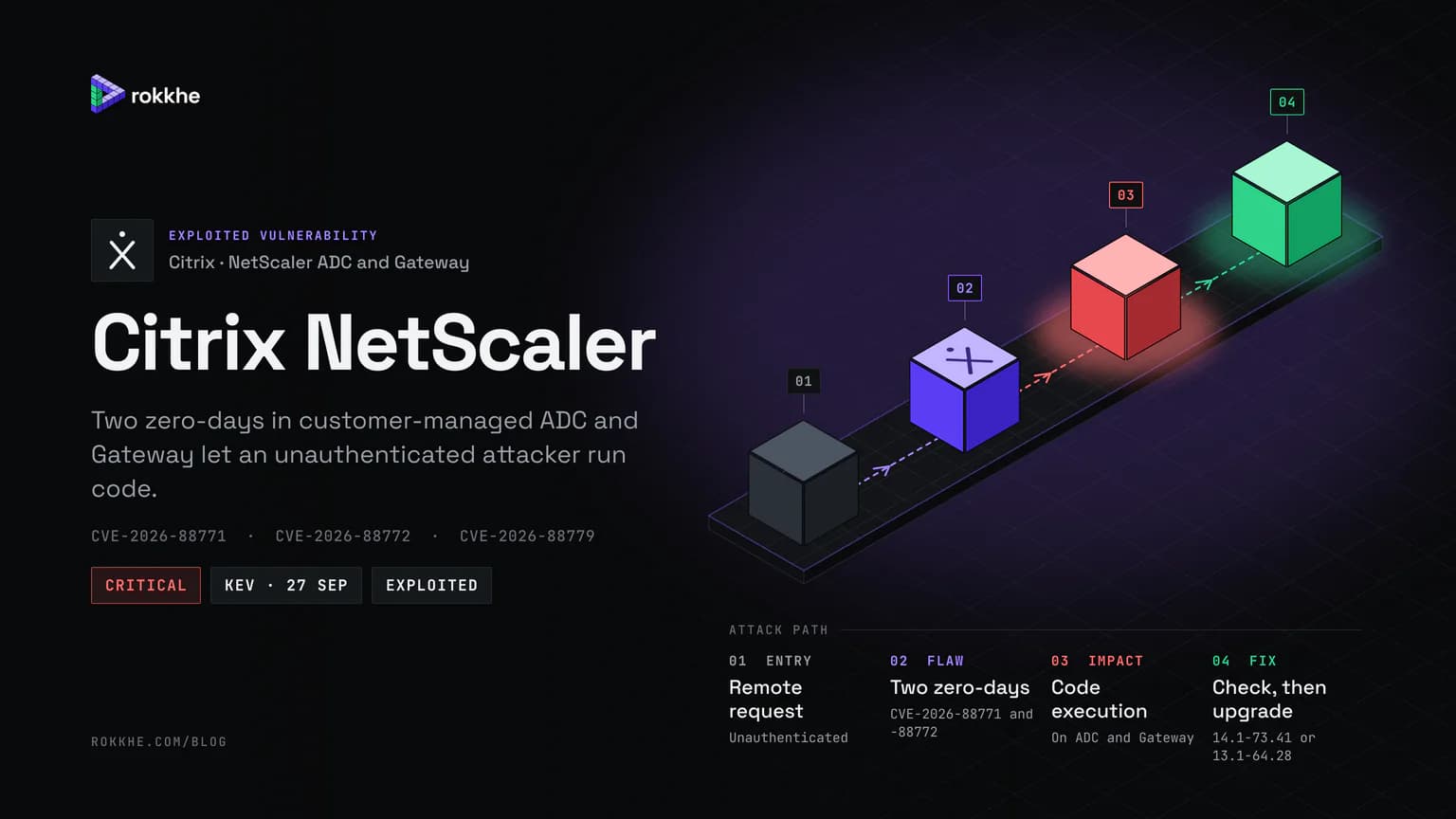
CVE-2026-88771 and CVE-2026-88772 are critical flaws in customer-managed Citrix NetScaler ADC and Gateway that let an unauthenticated attacker run code. Citrix reports both exploited, and CISA added them to its KEV catalog on 27 September 2026. CVE-2026-88779, a SAML denial-of-service bug listed on 4 October, needs later builds. Check for compromise first, then upgrade to 14.1-73.41, 13.1-64.28 or the matching FIPS and NDcPP builds.
The attack path
Four steps, from the way in to the fix.
Most NetScaler advisories describe bugs that need a particular feature switched on. CVE-2026-88771 does not: Citrix lists its precondition as every deployment in the default configuration, and it lets an unauthenticated attacker run commands on the appliance. Its companion, CVE-2026-88772, is a memory overflow reached over DTLS, which VPN virtual servers enable by default.
Unit 42 found attackers fingerprinting appliances from 21 August 2026 and using web shells planted on them from 4 to 24 September, all before disclosure. Citrix published bulletin CTX697096 on 27 September, and CISA added both CVEs to its Known Exploited Vulnerabilities catalog the same day. On 3 October Citrix published a separate bulletin, CTX697174, for CVE-2026-88779, a SAML denial-of-service bug fixed only in later builds. CISA listed it on 4 October.
Who is affected
Customer-managed NetScaler ADC and NetScaler Gateway, including Secure Private Access hybrid deployments that use NetScaler instances. Citrix says Cloud Software Group updates its own managed cloud services.
| Branch | Fixes CVE-2026-88771 and -88772 | Also fixes CVE-2026-88779 |
|---|---|---|
| 14.1 | 14.1-73.37 | 14.1-73.41 |
| 13.1 | 13.1-64.23 | 13.1-64.28 |
| 14.1 FIPS | 14.1-73.37 FIPS | 14.1-73.41 FIPS |
| 13.1 FIPS and NDcPP | 13.1-37.279 | 13.1-37.282 |
The preconditions differ. CVE-2026-88771 needs only the default configuration. CVE-2026-88772 needs DTLS: a Gateway is exposed unless DTLS is explicitly turned off, as is any other virtual server of type DTLS. CVE-2026-88779 needs the appliance to act as a SAML service provider or identity provider.
How the NetScaler flaws work
CVE-2026-88771: command execution without a login
Citrix classifies it as improper input validation (CWE-20) and scores it 9.5 in CVSS 4.0; NVD's CVSS 3.1 score is 9.8. Unit 42 watched a three-stage chain against a US target on 21 September. The attacker gets crafted text written into ns.log through a failed login, and a Perl script on the appliance later processes that log and runs the planted text as a command.
CVE-2026-88772: a memory overflow over DTLS
Citrix describes a memory overflow (CWE-119) that can lead to code execution or denial of service, also 9.5 in CVSS 4.0 but with high attack complexity. NVD scores it 8.1. Unit 42 tied it to the web shells: the attacker repeatedly fetched .deb files from /vpn/scripts/linux/, a folder that normally holds client installation packages.
CVE-2026-88779: a SAML crash, and what CISA adds
Citrix calls this a memory overflow (CWE-119) that leads to denial of service, scored 8.7 in CVSS 4.0 with an availability impact only. Its bulletin says nothing about code execution or reboots.
CISA goes further. Its alert, updated 9 October, says attackers may use the bug on unpatched systems to force a reboot that speeds up execution of code already planted through CVE-2026-88771. That is CISA's assessment, not Citrix's classification.
Is it being exploited?
Yes, by several primary accounts:
- Citrix reports exploits of CVE-2026-88771 and CVE-2026-88772 against unmitigated appliances. Its CVE-2026-88779 bulletin does not say whether that bug was exploited.
- CISA added the first two to KEV on 27 September with a 30 September deadline and forensic triage required, and CVE-2026-88779 on 4 October with a 7 October deadline.
- Unit 42 traced fingerprinting to 21 August, with the same requests sent to more than 100 other systems over two days. Web shell requests ran from 4 to 24 September, and a separate stream of attacker requests ended at 01:54 UTC on 27 September, hours before Citrix published. Unit 42 names no actor.
Unit 42 also counted 50,277 exposed instances that could be vulnerable, as of 27 September.
Check your exposure
Confirm your build, the preconditions and the published indicators before you patch:
# Gateway and AAA vservers; a VPN vserver without "-dtls OFF" meets the 88772 precondition
grep -E "^add (vpn|authentication) vserver" /nsconfig/ns.conf

# SAML service provider or identity provider: the 88779 precondition
grep -E "add authentication (samlAction|samlIdPProfile)" /nsconfig/ns.conf

# Web shell locations and Apache entries Unit 42 published
ls -la /vpn/scripts/linux/ /var/netscaler/logon/LogonPoint/custom/
grep -n "ctxs.receiver" /etc/httpd.conf

# Log poisoning marker from Unit 42's hunting query
grep -i "pitboss" /var/log/ns.log
Local logs rotate quickly, which is why CISA advises forwarding NetScaler logs to a SIEM. CISA also says Citrix has made indicators of compromise available through NetScaler Console.
Fix it
Follow CISA's order: look for compromise, preserve evidence, then patch. Updating can reduce what investigators can see afterward.
Upgrade to the builds in the right-hand column of the table; Citrix offers no workaround for these three CVEs. If you find signs of compromise, Citrix's CTX694799 sets out the recovery:
- Preserve evidence: VPX snapshots, remote syslog and NetScaler Console logs, a support bundle and a Packet Engine core dump.
- Isolate the appliance.
- Revoke service account secrets, RADIUS shared secrets, OAuth tokens, API keys, SNMP community names and certificates, and reset accounts that signed in through the Gateway or AAA virtual servers.
- Investigate connected systems, especially authentication servers and management jump hosts.
- Wipe MPX appliances or replace VPX instances, upgrade, then restore a backup that predates the compromise.
- Change local passwords, rotate key encryption keys, replace restored certificates and monitor for at least 90 days.
Detect attempts and compromise
Unit 42 published these signals:
- Web shell files.
/vpn/scripts/linux/nsg64.deb,/vpn/scripts/linux/nsgclient18.deband/var/netscaler/logon/LogonPoint/custom/.ctxs.receiver. The SHA-256 ofnsg64.debisae22ef2517b5c0fb47f78745b9cb5260acee0e751b89bcd354640ff8bc8d29ec. - Apache changes. A
<Files ".ctxs.receiver">block in/etc/httpd.conf, aliases that serve the shell under a stylesheet-like path, and the PHP engine switched on. - Privilege changes.
/bin/shwith the SUID and SGID bits set. - Poisoned logs.
pitbosslines with "PPE missed too many heartbeats" or "PPE unexpectedly died" followed by shell-like text. On a patched appliance a match shows an attempt, not execution. - Odd requests. Any traffic to
/logon/LogonPoint/Authentication/GetUserName, which Unit 42 considers worth investigating.
Unit 42 also lists nine IP addresses as network indicators, and CISA has published Sigma rules for this activity. If any signal fired, treat the appliance as compromised and follow CTX694799.
Beyond this patch
These appliances were attacked weeks before a CVE number existed. Disclosure is a prompt to hunt for compromise, and the evidence often lives only on the box until logs rotate. Forwarding appliance logs off the device keeps that history; the SOC pipeline docs explain how Rokkhe turns forwarded events into cases with evidence attached.
Frequently asked questions
Am I affected if I do not use NetScaler Gateway?
Yes. Citrix lists the precondition for CVE-2026-88771 as every deployment in the default configuration, so a plain ADC is in scope. CVE-2026-88772 needs DTLS, which Gateway virtual servers have on unless it is explicitly disabled. CVE-2026-88779 needs the appliance to act as a SAML service provider or identity provider. Customer-managed ADC and Gateway on 14.1 and 13.1, including FIPS and NDcPP builds, are affected.
Is there a workaround if I cannot upgrade today?
No. Citrix's bulletins give no workaround for CVE-2026-88771, CVE-2026-88772 or CVE-2026-88779; the only fix is the upgraded build. Until you can upgrade, CISA's advice still applies: check the published indicators, preserve evidence and forward NetScaler logs to a SIEM, because local logs rotate quickly. Plan the upgrade to 14.1-73.41 or 13.1-64.28 so one maintenance window covers all three CVEs.
Does patching remove an attacker who already got in?
No. Unit 42 notes that updating will not remove access an attacker has already established, and the web shells it documented were registered through edits to the appliance's Apache configuration. CISA advises looking for indicators and preserving evidence before patching. If you find signs of compromise, follow Citrix's CTX694799: isolate, revoke credentials and certificates, rebuild or replace the appliance, and restore only a backup that predates the compromise.
Can CVE-2026-88779 lead to code execution?
Citrix classifies CVE-2026-88779 as a denial of service and its bulletin does not mention code execution or reboots. CISA's alert adds that on unpatched systems attackers may use it to force a reboot that speeds up execution of code already planted through CVE-2026-88771. Treat it as part of the same campaign and patch to 14.1-73.41, 13.1-64.28 or the matching FIPS and NDcPP builds.
How do I detect a NetScaler compromise from this campaign?
Unit 42 published file indicators, including /vpn/scripts/linux/nsg64.deb and a hidden PHP shell at /var/netscaler/logon/LogonPoint/custom/.ctxs.receiver. Look for matching entries in /etc/httpd.conf, a /bin/sh binary with SUID and SGID bits set, and pitboss lines in ns.log followed by shell-like text. Unit 42 also lists nine IP addresses, and CISA has published Sigma rules for the activity.
Sources
- Citrix — CTX697096: NetScaler ADC and Gateway security bulletin (CVE-2026-88771 to -88778)
- Citrix — CTX697174: NetScaler ADC and Gateway security bulletin for CVE-2026-88779
- Citrix — CTX694799: Steps to take if NetScaler ADC is suspected to be compromised
- CISA — Critical Zero-Day Vulnerabilities Exploited in Citrix NetScaler ADC, Gateway
- CISA — Known Exploited Vulnerabilities catalog (JSON feed)
- NVD API — CVE-2026-88771
- NVD API — CVE-2026-88772
- NVD API — CVE-2026-88779
- Unit 42 — Threat Brief: NetScaler Zero Days CVE-2026-88771 and CVE-2026-88772 Exploited in the Wild
Published 28 October 2026 · By the Rokkhe research team