GitLab commits API path traversal: CVE-2026-85706
An unauthenticated file read in GitLab's repository commits API, in CISA KEV since 11 September 2026. Affected ranges after the backports, detection and fixes.
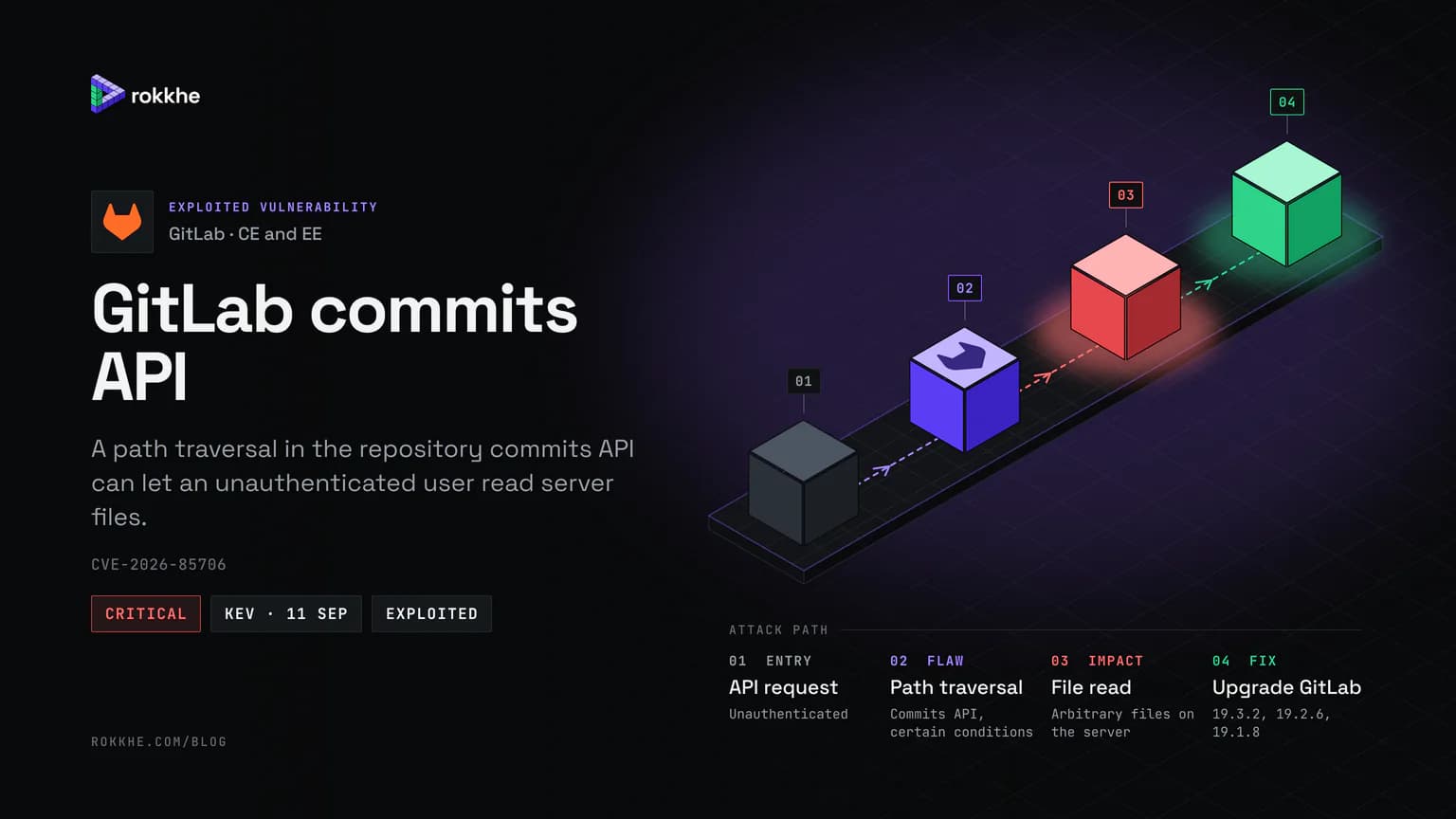
CVE-2026-85706 is a path traversal in the repository commits API of GitLab CE and EE that, under certain conditions, lets an unauthenticated user read arbitrary files from the server. It affects 18.7 and later. Fixes are 19.3.2, 19.2.6 and 19.1.8 from 10 September 2026, plus backports 19.0.9 and 18.11.12 from 23 September. CISA added it to its KEV catalog on 11 September 2026. Upgrade, and review commits API traffic.
The attack path
Four steps, from the way in to the fix.
Most GitLab advisories assume a signed-in user, a project role or a crafted merge request. CVE-2026-85706 assumed none of those. Under conditions GitLab has not spelled out, a request to the repository commits API with no credentials could read arbitrary files from the server, which on a GitLab host can include configuration files and secrets. GitLab scored it 10.0.
GitLab shipped fixes for three branches on 10 September 2026. CISA added the bug to its Known Exploited Vulnerabilities catalog the next day with a 14 September deadline, and watchTowr reported probes in its honeypots within a day of the patch. On 23 September GitLab backported the fix to two older branches, so the affected range is wider than the first announcement suggested.
Who is affected
GitLab Community Edition and Enterprise Edition, self-managed, from 18.7 onward:
| Branch | Fixed in | Released |
|---|---|---|
| 19.3 | 19.3.2 | 10 September 2026 |
| 19.2 | 19.2.6 | 10 September 2026 |
| 19.1 | 19.1.8 | 10 September 2026 |
| 19.0 | 19.0.9 | 23 September 2026 (backport) |
| 18.11 | 18.11.12 | 23 September 2026 (backport) |
| 18.7 to 18.10 | No fix in branch; upgrade to a fixed release | — |
GitLab.com already runs the fix, and GitLab Dedicated customers need take no action. GitLab does not list releases before 18.7 as affected.
GitLab's description of the trigger is only "certain conditions". Some secondary write-ups name a specific project setting as the condition, but GitLab has not confirmed that, so do not treat project visibility as a defense.
How the path traversal works
CVE-2026-85706
GitLab describes two failures in one endpoint: the repository commits API did not confine file paths, and it did not enforce authentication. Together they let a request with no credentials name a path outside where it should be allowed and get the file contents back. NVD classifies the bug as CWE-22, path traversal; CISA's catalog lists CWE-35, a narrower path traversal variant.
GitLab's vector, AV:N/AC:L/PR:N/UI:N/S:C/C:H/I:H/A:N, rates integrity high as well as confidentiality, although its description covers file reads only. GitLab credits the researcher s3ntago, who reported it through HackerOne.
Related, not exploited: CVE-2026-97229 and CVE-2026-110264
Two later GitLab bugs share the 10.0 score but work differently. Both are integer overflows in GitLab's regular expression compiler that, under certain conditions, could let an unauthenticated user run code on the server.
- CVE-2026-97229 was fixed on 12 October 2026 in 19.4.2, 19.3.5 and 19.2.8. It affected only 19.2 through 19.4 and involves a crafted regular expression in a CI/CD configuration.
- CVE-2026-110264 was fixed on 21 October 2026 in 19.5.1, 19.4.3, 19.3.6, 19.2.9, 19.1.9, 19.0.10 and 18.11.13. Its affected range reaches back to GitLab 7.0.
Neither is in the KEV catalog, and CISA's assessments on NVD record no exploitation for either. GitLab does not describe the second as an incomplete fix for the first. Its published ranges do, however, place the 12 October builds inside CVE-2026-110264's affected range, so an instance patched on 12 October still needs the 21 October release. That conclusion is our reading of the ranges, not a GitLab statement.
Is it being exploited?
CISA added CVE-2026-85706 to the KEV catalog on 11 September 2026, with a due date of 14 September. The entry marks forensic triage as required under BOD 26-04 and lists ransomware use as unknown. GitLab's release post cites the listing but does not describe specific attacks.
watchTowr published a rapid reaction on 11 September saying its honeypot network was already seeing probes for the bug and that it expected indiscriminate exploitation. That is evidence of scanning activity. None of the sources reviewed here publish details of a confirmed compromise.
Check your exposure
On Linux package installations, confirm the version and look at recent traffic to the commits API:
# Shows the GitLab version and environment
sudo gitlab-rake gitlab:env:info

# POST requests to the repository commits API
sudo grep 'repository/commits' /var/log/gitlab/gitlab-rails/api_json.log | grep POST

# Narrow to watchTowr's pattern: requests carrying a file.path parameter
sudo grep 'repository/commits' /var/log/gitlab/gitlab-rails/api_json.log | grep -F 'file.path'

# The same endpoint at the NGINX layer
sudo grep -E 'POST /api/v4/projects/[^ ]+/repository/commits' /var/log/gitlab/nginx/gitlab_access.log
Legitimate tools also post to this endpoint to create commits, so expect some noise. GitLab's API log records the user ID and username for each request, which helps separate anonymous calls from your own automation. Self-compiled installations use bundle exec rake gitlab:env:info RAILS_ENV=production for the version check.
Fix it
Upgrade to the fixed release for your branch; instances on 18.7 through 18.10 should move to 18.11.12 or later. Because CVE-2026-110264 also affects every branch in the table above, the practical target is the 21 October patch release for your branch, which also carries this fix.
GitLab lists no workaround. watchTowr's interim advice is to remove public access to self-managed instances that cannot be patched immediately. If you are following the BOD 26-04 triage guidance, collect logs and other evidence before you patch.
A patch closes the hole but does not undo reads that already happened. If the checks above turn up anonymous requests you cannot explain, treat secrets the GitLab server can read as exposed and rotate them.
Detect attempts and compromise
GitLab's release post names three detections for self-managed instances, without publishing their logic:
- gitlab.yml reads. An attempt to read the
gitlab.ymlconfiguration file. - metadata.path parameter. A file read through a
metadata.pathparameter. - File path attempts. A generic file path read attempt.
watchTowr's hunting pattern is different: POST requests to /api/v4/projects/{id}/repository/commits/ that carry a file.path parameter. GitLab's rule names mention metadata.path; watchTowr's pattern mentions file.path. Neither source publishes full indicators, so hunt for both and review every unauthenticated request to the endpoint.
If any of these fired before you patched, treat the instance as compromised. Work through scoping, evidence collection and containment, decide whether files were read, and rotate what was readable.
Beyond this patch
Two lessons outlast this release. Check a vendor's advisory again a week after it ships: here the affected range and the fix list both changed after publication. And keep the secrets a server can read few and easy to rotate, because a file-read bug hands them to whoever finds it first.
Frequently asked questions
Am I affected if I run GitLab 18.11 or 19.0?
Yes, until you reach 18.11.12 or 19.0.9. GitLab's first fixes on 10 September 2026 covered only 19.1, 19.2 and 19.3. On 23 September it backported the fix to 19.0.9 and 18.11.12. Instances on 18.7 through 18.10 have no fix in their own branch and need to upgrade. GitLab.com and GitLab Dedicated are already patched.
Is CVE-2026-85706 being exploited?
CISA added it to the Known Exploited Vulnerabilities catalog on 11 September 2026, the day after the patch, with a 14 September deadline and forensic triage required. watchTowr reported probes for the bug in its honeypot network and expected indiscriminate exploitation, but did not report confirmed compromises. GitLab cites the KEV listing without describing specific attacks.
How do I detect attempts against the commits API?
GitLab published three detections for self-managed instances: an attempt to read gitlab.yml, a file read through a metadata.path parameter, and a generic file path attempt. watchTowr suggests hunting for POST requests to /api/v4/projects/{id}/repository/commits/ that carry a file.path parameter. Neither published full indicators, so use both and review unauthenticated requests to that endpoint.
Is there a workaround if I cannot upgrade GitLab yet?
GitLab lists no workaround and recommends upgrading as soon as possible. watchTowr's interim advice for self-managed instances is to remove public access until they are patched. That narrows who can reach the API but does not fix the flaw, and it does nothing about files that may already have been read.
Are the GitLab regex RCEs CVE-2026-97229 and CVE-2026-110264 related?
They are separate bugs: integer overflows in GitLab's regular expression compiler that could allow unauthenticated code execution, both scored 10.0 by GitLab. Neither is in the KEV catalog. CVE-2026-97229 was fixed on 12 October 2026 and CVE-2026-110264 on 21 October. By GitLab's published ranges, the 12 October builds fall inside CVE-2026-110264's affected range.
Sources
- GitLab — Patch release 19.3.2, 19.2.6, 19.1.8 (CVE-2026-85706; updated 23 Sept 2026)
- CISA Known Exploited Vulnerabilities catalog — CVE-2026-85706
- CISA KEV catalog JSON feed
- CISA — BOD 26-04 implementation guidance (forensic triage requirements)
- NVD API — CVE-2026-85706
- watchTowr — Rapid reaction: GitLab path traversal CVE-2026-85706
- GitLab — Patch release 19.4.2, 19.3.5, 19.2.8 (CVE-2026-97229)
- GitLab — Patch release 19.5.1 and backports (CVE-2026-110264)
- NVD API — CVE-2026-97229
- NVD API — CVE-2026-110264
- GitLab Docs — Log system (log file locations)
- GitLab Docs — Maintenance Rake tasks (gitlab:env:info)
Published 28 October 2026 · By the Rokkhe research team