Five old CVEs in CISA KEV: BIND, Struts, ProFTPD, ONLYOFFICE, Strapi
CISA added five CVEs from 2015 to 2023 to KEV on 8 October 2026. Why old bugs land there, who still runs them, and how to check and fix each one.
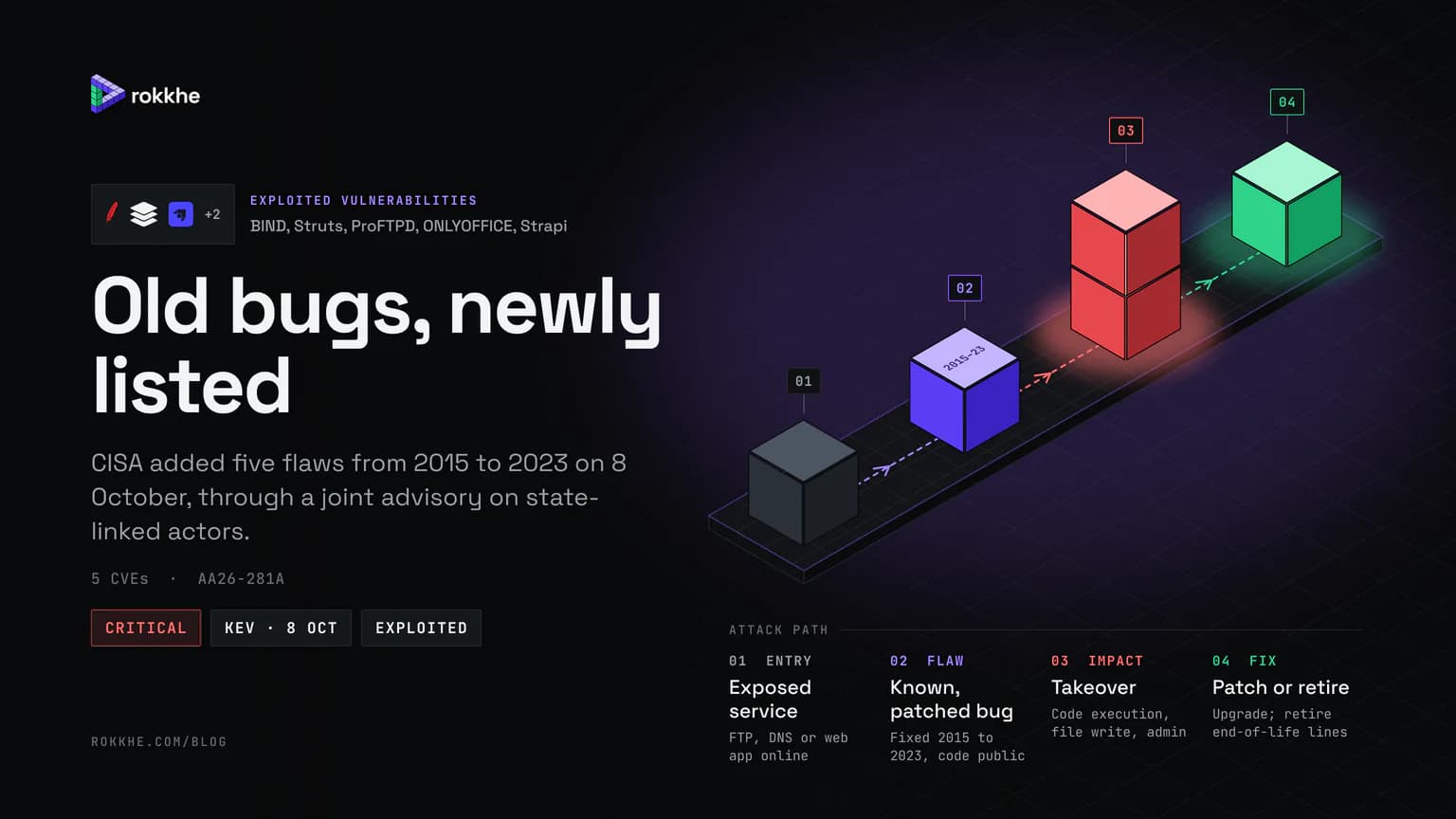
On 8 October 2026 CISA added five long-patched CVEs to its Known Exploited Vulnerabilities catalog: ISC BIND CVE-2015-5477, Apache Struts CVE-2016-3081, ProFTPD CVE-2015-3306, ONLYOFFICE Docs CVE-2021-3199 and Strapi CVE-2023-22894. Joint advisory AA26-281A lists them in FBI-recovered tooling of China-linked actors, without exploitation dates. Find exposed instances, upgrade, retire end-of-life Struts 2.3 and Strapi 3 and 4, and check exposed hosts for compromise.
The attack path
Four steps, from the way in to the fix.
On 8 October 2026 CISA added five vulnerabilities to its Known Exploited Vulnerabilities catalog that most teams patched, or meant to, years ago: a BIND crash from 2015, an Apache Struts code-execution bug from 2016, the ProFTPD mod_copy flaw from 2015, an ONLYOFFICE Docs path traversal fixed in 2020 and a Strapi data leak from 2023. Every one has had a vendor fix for more than three and a half years.
They did not arrive with the usual "CISA Adds Known Exploited Vulnerabilities" alert. They arrived inside joint advisory AA26-281A, published the same day by the FBI, CISA, NSA and agencies from the UK, Australia, Canada, Japan, New Zealand and Spain, about Chinese government-linked actors "enabled by the Integrity Technology Group". Its appendix lists eight CVEs the actors "successfully exploited" and marks these five as newly added to KEV. The federal deadline was three days later, Sunday 11 October.
This briefing covers why old bugs land in KEV, what each of the five is, who is likely still running affected versions, and how to check and fix each one.
Why 2015 bugs land in KEV in 2026
KEV lists vulnerabilities with evidence of exploitation, not new ones. CISA's conditions are a CVE ID, "reliable evidence of active exploitation in the wild", a clear remediation and significant risk to federal systems. Age is not among them. CISA's BOD 26-04 guidance says a vulnerability "may qualify for inclusion in the KEV Catalog at any time, regardless of its age", and that CISA "does not assume that all running legacy products are fully patched".
Here the evidence came from FBI investigations. AA26-281A says its information "originates from technical evidence recovered from, and observed during, multiple Federal Bureau of Investigation (FBI) investigations related to Integrity Technology Group". It describes MicroScan, a web application with more than 1,300 penetration-testing scripts that the actors used "as early as 2017", and says its CVE table was "recovered from penetration testing scripts". It does not say when each CVE was used, against whom, or whether any is still in use.
That gap matters. CISA's FAQ says the addition of an older CVE "does not necessarily indicate that CISA is currently observing active exploitation." What the listing does establish is that a capable actor kept working exploits for these bugs, and that anything still running them is exposed to the same automated scanning.
The three-day deadline comes from BOD 26-04, which replaced BOD 22-01 in June 2026. CISA now derives each KEV due date from asset exposure, automation and technical impact: on a publicly exposed asset, a KEV vulnerability with total technical impact gets three days plus a "forensic triage" to check whether the asset is already compromised. All five carry the 11 October date, and CISA's records rate all five as total technical impact:
| CVE | Product | Vendor fix | Automatable (CISA) | Forensic triage (KEV) |
|---|---|---|---|---|
| CVE-2015-5477 | ISC BIND | July 2015 | Yes | No |
| CVE-2016-3081 | Apache Struts | April 2016 | No | Yes |
| CVE-2015-3306 | ProFTPD | May 2015 | Yes | Yes |
| CVE-2021-3199 | ONLYOFFICE Docs | August 2020 | Yes | Yes |
| CVE-2023-22894 | Strapi | March 2023 | No | Yes |
BIND stands out: ISC describes a crash, CISA's record still rates its impact as total, and the KEV entry asks for no forensic triage. CISA has not published its reasoning.
ISC BIND: CVE-2015-5477
What it is. A crafted query for a TKEY record makes named fail a REQUIRE assertion and exit. ISC rated it critical, said "both recursive and authoritative servers are vulnerable", and warned that ACLs and configuration limits do not help, because the faulty code runs "early in the packet handling, before checks enforcing those boundaries". There was no workaround. The result is denial of service: the DNS server stops. ISC credits Jonathan Foote, published on 28 July 2015, and noted on 1 August that proof-of-concept code was public.
| Affected (ISC) | Fixed | Today |
|---|---|---|
| 9.1.0 to 9.8.x, 9.9.0 to 9.9.7-P1, 9.10.0 to 9.10.2-P2 | 9.9.7-P2 and 9.10.2-P3 (July 2015) | ISC's current stable branch is 9.20; 9.18 reached end of life in the second quarter of 2026 |
Who still runs it. Old Linux images and appliances. NVD's affected configurations go well beyond ISC's builds: Red Hat Enterprise Linux 5 to 7, Debian 7 and 8, Ubuntu 12.04, Solaris, HP-UX, Juniper Junos and NetApp clustered Data ONTAP.
How to check. Ask the package manager, not the version string, because distributions backported the fix. Red Hat fixed RHEL 7 in bind-9.9.4-18.el7_1.3 and RHEL 6 in bind-9.8.2-0.37.rc1.el6_7.2, both of which show an upstream version inside ISC's affected range. For appliances, go by the vendor's advisory; the KEV entry links Juniper's.
named -v                                   # upstream version of the local binary
rpm -q bind || dpkg -l 'bind9*'            # distribution package and its patch level
dig @ns1.example.com version.bind chaos txt +short   # what your server reports, if not hidden
How to fix. Upgrade to a supported BIND from ISC or your distribution, or to the appliance vendor's fixed firmware. Since ACLs do not protect against this bug, restricting who can query is no substitute.
Apache Struts: CVE-2016-3081 (S2-032)
What it is. When Dynamic Method Invocation (DMI) is enabled, a request can pass an expression through the method: prefix that runs code on the server. Apache's bulletin S2-032 rates it Important, with "Possible Remote Code Execution"; NVD scores it 8.1. Apache credits Nike Zheng and released the fixes on 19 April 2016.
| Affected (S2-032) | Fixed | Today |
|---|---|---|
| 2.3.20 to 2.3.28, except 2.3.20.3 and 2.3.24.3 (the CVE record starts at 2.3.19) | 2.3.20.3, 2.3.24.3 and 2.3.28.1 | The whole 2.3.x branch has been end of life since 12 September 2019 |
Who still runs it. Java web applications that never left Struts 2.3, and products that bundle it: NVD lists Huawei OceanStor storage firmware and Oracle applications including FLEXCUBE Private Banking and Siebel e-Billing. Configuration decides exposure. Struts's own default.properties has shipped with DMI off since 2.3.15.2, so an application is vulnerable only if its configuration switches DMI on.
How to check. Find every struts2-core jar, including those packed inside WAR and EAR files, then look for the DMI setting in the deployed configuration.
# Struts jars on disk, including unpacked web apps
find / -xdev -name 'struts2-core-*.jar' 2>/dev/null
# Struts packed inside WAR and EAR files
find / -xdev \( -name '*.war' -o -name '*.ear' \) 2>/dev/null | while read -r f; do
  unzip -l "$f" 2>/dev/null | grep -q 'struts2-core' && echo "$f"
done
# Applications that switch Dynamic Method Invocation on
grep -rn 'struts.enable.DynamicMethodInvocation' /path/to/webapps 2>/dev/null
unzip -p app.war WEB-INF/classes/struts.xml | grep -n 'DynamicMethodInvocation'
Jars nested inside other jars escape a simple search; software composition analysis finds those.
How to fix. For the vulnerable branch, Apache's options were to disable DMI or upgrade to 2.3.20.3, 2.3.24.3 or 2.3.28.1. With 2.3.x out of support for seven years, the lasting fix is a migration to a supported Struts release; the project lists 7.4.0 as its best available. Until then, set DMI to false and confirm it in the deployed artifact, not the source tree. For a vendor product, the fix has to come from the vendor.
ProFTPD: CVE-2015-3306 (mod_copy)
What it is. ProFTPD's mod_copy module adds the SITE CPFR and SITE CPTO commands for copying files on the server. In 1.3.5 it accepted them from clients that had not logged in, so anyone who could reach the FTP port could copy any file the server could read to anywhere it could write. The original report, from Vadim Melihow, showed a copy of /etc/passwd and a PHP file written where a web server would run it, which is how a file copy becomes code execution. Debian's advisory says the flaw could "possibly" allow arbitrary code execution; CISA's record scores it 10.0 in CVSS 3.1.
| Affected | Fixed | Today |
|---|---|---|
| 1.3.5 with mod_copy (the report's example server ran 1.3.5rc3) | 1.3.5a (27 May 2015) and 1.3.6rc1 | Maintenance release 1.3.9e; 1.3.10rc5 is the release candidate |
Who still runs it. Long-lived Linux hosts and devices with FTP switched on. ProFTPD's documentation says mod_copy "is not compiled by default", but Debian's package included it, and Debian's fix for jessie, 1.3.5-1.1+deb8u1, still reports version 1.3.5. AA26-281A says the actors concentrate their scans on a handful of ports, and port 21 is one of them.
How to check.
proftpd -v                          # version
proftpd -l | grep -i mod_copy       # mod_copy compiled in statically
grep -rn 'mod_copy' /etc/proftpd* /usr/local/etc/proftpd* 2>/dev/null   # loaded as a shared module
dpkg -l 'proftpd*' || rpm -q proftpd   # distribution patch level
nmap -sV -p 21 192.0.2.0/24         # banners on ranges you own and may scan
How to fix. Upgrade to a current ProFTPD or your distribution's patched package. If you do not use mod_copy, do not load it; from 1.3.6rc1, CopyEngine off disables it without a rebuild. The ProFTPD maintainer added that directive with the fix so that future mod_copy problems could be switched off at runtime. Then ask whether the FTP service needs to face the internet at all.
ONLYOFFICE Docs: CVE-2021-3199
What it is. A path traversal in Document Server's /upload handler: when JWT is in use, a /.. sequence in an image upload parameter writes outside the intended folder, which the CVE record says can lead to remote code execution. NVD scores it 9.8. ONLYOFFICE's changelog for 5.6.3 lists a single back-end fix: "Fix Path Traversal vulnerability via image upload params (Bug #46113)". The CVE ID dates from January 2021, but the fix shipped in August 2020.
| Affected | Fixed | Today |
|---|---|---|
| Before 5.6.3 (AA26-281A lists 5.1.5 through 5.6.2) | 5.6.3, released 17 August 2020 | 10.0.0, released 12 October 2026 |
Who still runs it. Self-hosted Document Server instances, from Docker images or packages, that have not been updated since 2020. The KEV entry notes that the flaw could affect a component used by other products, so check anything that bundles Document Server too.
How to check.
docker ps --format '{{.Image}}  {{.Names}}' | grep -i 'onlyoffice/documentserver'
dpkg -s onlyoffice-documentserver 2>/dev/null | grep '^Version'
rpm -q onlyoffice-documentserver
An image tagged latest tells you nothing until you know when it was last pulled.
How to fix. Upgrade to a current release. CISA asks for forensic triage on this one, so an instance that faced the internet on 5.6.2 or earlier needs a look for files written where they should not be, not only an upgrade.
Strapi: CVE-2023-22894
What it is. Strapi's query filters let a user filter records on fields that should stay private, such as password hashes and reset tokens, and infer their values from the responses. The CVE record describes an attacker with admin panel access; with super admin access, that means the password hash and reset token of every user. Strapi's own disclosure goes further. The researcher, GhostCcamm, later found a way to exploit it without logging in, and chained it with CVE-2023-22621, a template injection in the users-permissions email templates, to run code on Strapi 4.5.5 and earlier. CISA's entry mentions the chain; CVE-2023-22621 itself is not in KEV.
The scores reflect that disagreement: NVD gives 4.9 on the assumption that admin access is needed, CISA's record 7.2, and Strapi's own vector assumes no privileges at all.
| Affected (Strapi) | Fixed | Today |
|---|---|---|
| 3.2.1 up to, but not including, 4.8.0 (the CVE record and AA26-281A say through 4.5.5) | 4.8.0, released 15 March 2023 | Strapi 3 and 4 are end of life; only 5.x is supported |
Who still runs it. Headless CMS back ends started on Strapi 3 or early 4 and never upgraded. Strapi's security policy marks 3.x end of life since 2022 and 4.x since April 2026, when its security fixes stopped. Every affected version is now also unsupported.
How to check. Read the installed version in each project, then run the log search Strapi published.
# Strapi 4 is the @strapi/strapi package; Strapi 3 is the unscoped strapi package
npm ls @strapi/strapi strapi
# Strapi's published pattern for requests that filter on private fields
grep -iE '(\[|%5B)\s*(email|password|reset_password_token|resetPasswordToken)\s*(\]|%5D)' /path/to/access.log
Strapi says repeated matches on the password or reset-token fields mean "you need to immediately start an incident response".
How to fix. Move to Strapi 5. Version 4.8.0 closed this bug, but 4.x no longer gets security fixes, and Strapi says 3.x never received a patch for it. If the log search matches, start incident response before or alongside the upgrade, as Strapi advises.
Is it being exploited?
What the listing establishes. CISA adds a CVE only with "reliable evidence of active exploitation in the wild". AA26-281A lists all five among the CVEs that actors enabled by Integrity Technology Group "successfully exploited", in tooling the FBI recovered. The advisory says these actors use techniques consistent with the activity industry calls Flax Typhoon, Ethereal Panda and Red Juliett, and cautions that vendor names may not map one to one to the US government's view. KEV lists ransomware use as unknown for all five.
What it does not establish. When each CVE was exploited, which victims were reached through which bug, or whether any of the five is being exploited today. The advisory gives no dates per CVE, and CISA's FAQ says an old CVE's addition "does not necessarily indicate" current exploitation.
What else is public. We found no vendor statement, honeypot data or incident report since 8 October showing new exploitation of these five; coverage so far repeats the advisory. Exploitation has been cheap for years, though. ISC noted public proof-of-concept code four days after disclosure, the CVE records for the Struts and ProFTPD bugs link Metasploit modules, the ONLYOFFICE record links proof-of-concept code, and Strapi describes the researcher's working chain.
The advisory's table also names three CVEs that were already in KEV: CVE-2014-6278 in GNU Bash, CVE-2019-11510 in Pulse Connect Secure and CVE-2021-22205 in GitLab. If this actor is in your threat model, check those as well.
Find them on your network
Everything here is read-only. Scan only systems you own or have written permission to test.
- Start from exposure. AA26-281A says the actors focus on ports 21 (FTP), 22 (SSH), 53 (DNS), 80 and 443 (HTTP and HTTPS) and 1080 (SOCKS). List what you expose on those ports first; an internet-facing FTP or DNS server is the obvious place to begin.
- Fingerprint, then confirm. Banners from
nmap -sVare a first pass for FTP and DNS, but backported packages and hidden banners make them wrong in both directions. Confirm on the host with the package manager. - Search inside software. Struts and Strapi arrive as dependencies. A software bill of materials or composition analysis finds
struts2-coreinside WAR files and@strapi/strapiin lockfiles that an installed-software list never shows. - Use vendor advisories for appliances. For devices with embedded BIND or Struts, NVD's configuration lists and the vendor's own bulletin are the reference, not the upstream version.
- Look for the actor, not only the bug. If a vulnerable instance was exposed, the advisory's indicators apply: SoftEther VPN clients installed for persistence, often renamed
conhost.exeordllhost.exe, plus the domains and file names in its appendix, which CISA publishes as STIX files.
Old bugs are the cheap ones
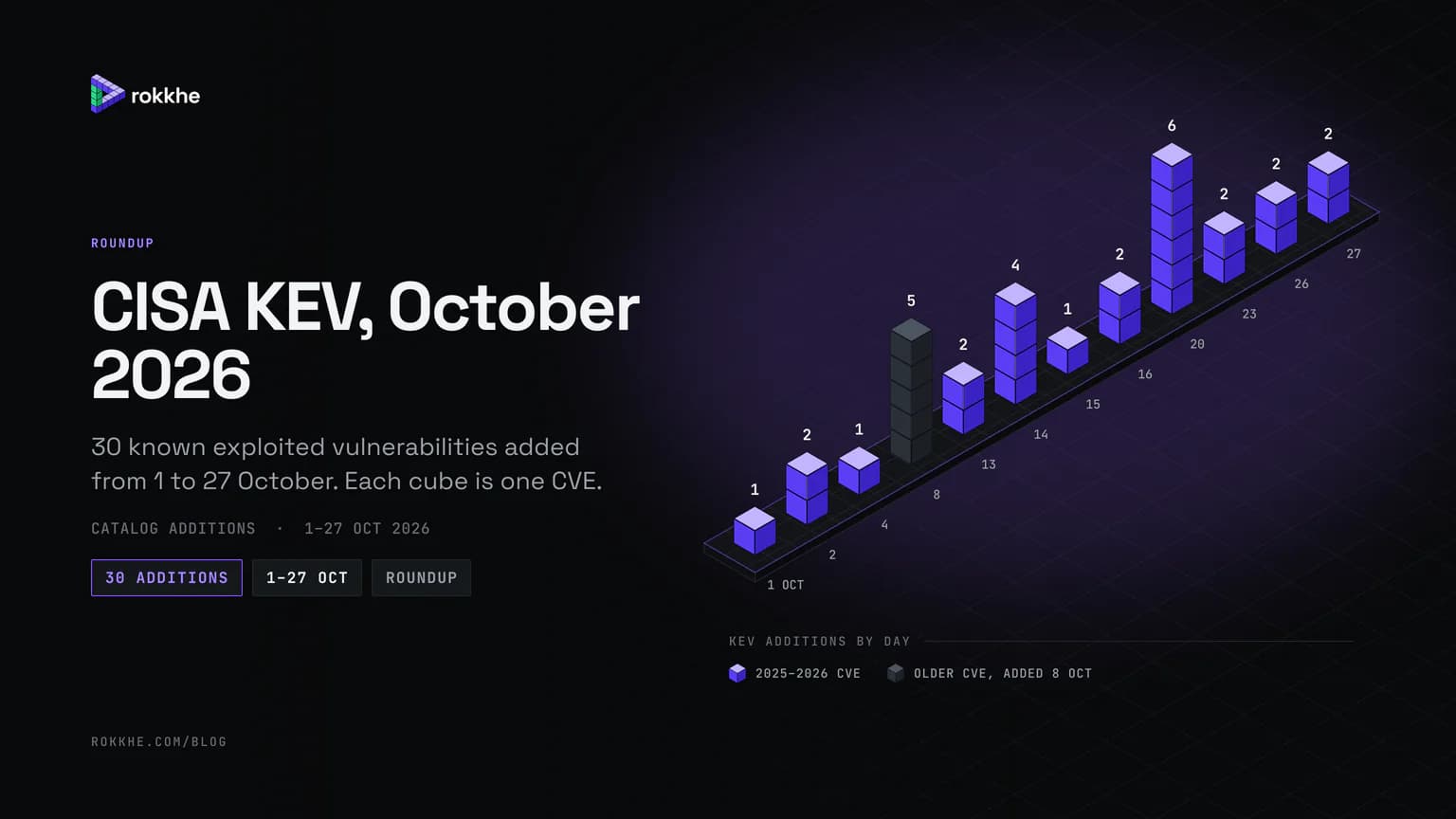
These five share a pattern: an exposed service nobody upgraded, a bug fixed years ago with public exploit code, and an actor whose scanner already knows it. The response is unglamorous: upgrade, retire what is out of support, and stop exposing services that have no reason to be public. Confirm the result with evidence, not a version string; how a retest verifies a fix explains Rokkhe's approach for findings it has reproduced. For the rest of October's additions, see the October KEV roundup.
Frequently asked questions
Why did CISA add vulnerabilities from 2015 to KEV in 2026?
KEV lists vulnerabilities with reliable evidence of exploitation, whatever their age. The evidence for these five came with joint advisory AA26-281A, which draws on FBI investigations into Integrity Technology Group and lists them among CVEs its actors successfully exploited. CISA says an old CVE can qualify at any time and that it does not assume legacy products are patched. A listing does not necessarily mean CISA sees exploitation today.
Are these five vulnerabilities being exploited right now?
That is not public. AA26-281A says the actors successfully exploited all five but gives no dates or victims per CVE, and KEV lists ransomware use as unknown. We found no vendor statement, honeypot data or incident report since 8 October showing new exploitation. Public exploit code has existed for years, though: Metasploit modules for the Struts and ProFTPD bugs, and proof-of-concept code for BIND and ONLYOFFICE.
My server reports BIND 9.9.4 or ProFTPD 1.3.5. Is it vulnerable?
Not necessarily. Distributions backported the fixes without changing the upstream version: Red Hat fixed RHEL 7 in bind-9.9.4-18.el7_1.3, and Debian fixed jessie's ProFTPD in 1.3.5-1.1+deb8u1. Compare the full package version with your distribution's advisory. ProFTPD 1.3.5 is affected only with mod_copy loaded, which the project does not compile by default.
What does the 11 October deadline mean outside the US government?
The deadline binds US federal civilian agencies under BOD 26-04, which gives three days, plus a forensic triage, for a KEV vulnerability with total technical impact on a publicly exposed asset. Everyone else can use the same logic: fix internet-facing instances first, and check any that were exposed for compromise, especially for the four entries where CISA requires forensic triage.
What if I cannot upgrade Struts 2.3 or Strapi 3 or 4?
Both are end of life: Struts 2.3 since September 2019, Strapi 3 since 2022 and Strapi 4 since April 2026. For Struts, Apache's documented workaround is to disable Dynamic Method Invocation. Strapi 3 never received a fix, and 4.8.0's fix gets no follow-up security updates. Take such systems off the internet while you migrate; CISA's required action is to stop using a product when no mitigation is available.
Sources
- CISA — AA26-281A: Chinese Government-linked Cyber Threat Actors Combine Automated and Hands-on Hacking Tools to Steal Sensitive Data
- CISA — Known Exploited Vulnerabilities catalog (JSON feed)
- CISA — BOD 26-04: Prioritizing Security Updates Based on Risk
- CISA — BOD 26-04 Implementation Guidance and KEV FAQ
- ISC — CVE-2015-5477: An error in handling TKEY queries can cause named to exit with a REQUIRE assertion failure
- ISC — BIND downloads and support status
- Red Hat — RHSA-2015:1513 bind security update
- Apache Struts — Security Bulletin S2-032
- Apache Struts — 2016 announcements (2.3.20.3, 2.3.24.3 and 2.3.28.1)
- Apache Struts — End-of-Life versions
- Apache Struts — default.properties at 2.3.28 (DMI default)
- ProFTPD Bugzilla — Bug 4169: Unauthenticated copying of files via SITE CPFR/CPTO allowed by mod_copy (archived copy)
- ProFTPD — mod_copy documentation
- ProFTPD — NEWS for 1.3.5a
- ProFTPD — releases (1.3.9e and 1.3.10rc5)
- Debian — DSA-3263-1 proftpd-dfsg security update
- ONLYOFFICE — Document Server changelog, 5.6.3
- ONLYOFFICE — Document Server releases
- Strapi — Security Disclosure of Vulnerabilities: CVE-2023-22893, CVE-2023-22621 and CVE-2023-22894
- Strapi — Security policy and supported versions
- NVD — CVE-2015-5477
- NVD — CVE-2016-3081
- NVD — CVE-2015-3306
- NVD — CVE-2021-3199
- NVD — CVE-2023-22894
Published 28 October 2026 · By the Rokkhe research team