Windows Shell Mark of the Web bypass: CVE-2026-96951
An exploited Windows Shell flaw lets a crafted file skip Mark of the Web warnings. CISA lists it as exploited. Affected builds, KBs and what to check.
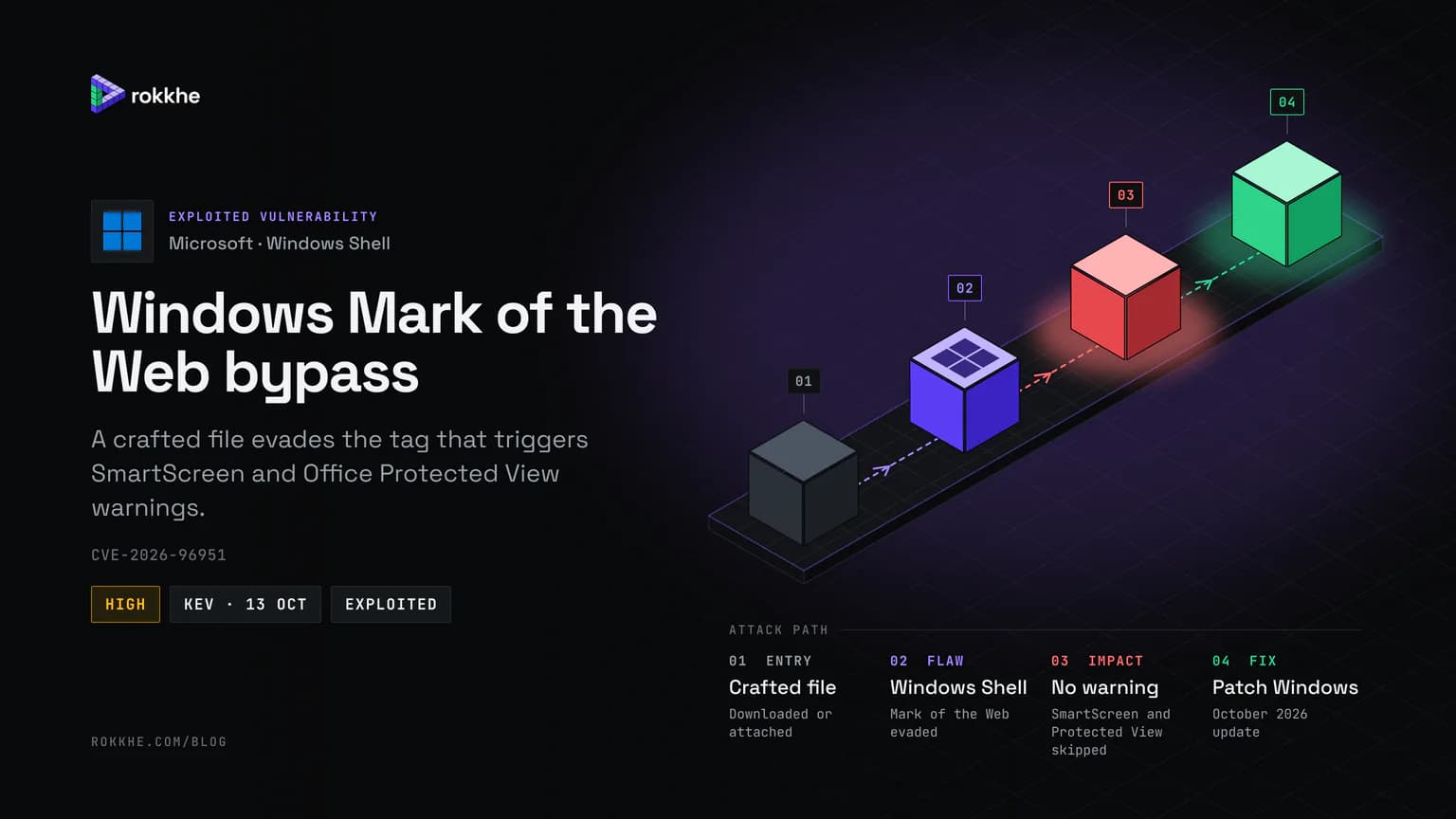
CVE-2026-96951 is a Windows Shell flaw that lets a crafted file evade Mark of the Web, the tag that triggers SmartScreen and Office Protected View warnings. It affects Windows 10, Windows 11 and Windows Server back to 2012 R2. Microsoft reports exploitation, and CISA added it to the KEV catalog on 13 October 2026. Install the October 2026 cumulative update; Microsoft lists no workaround.
The attack path
Four steps, from the way in to the fix.
Mark of the Web is the tag Windows attaches to files that arrive from the internet. SmartScreen, Office Protected View and similar checks rely on it to decide when to warn or restrict. CVE-2026-96951 is a flaw in Windows Shell that lets a crafted file get past those checks, and attackers were already using it before the fix shipped.
Microsoft fixed it on 13 October 2026 and marked it as exploited. CISA added it to its Known Exploited Vulnerabilities catalog the same day and gave federal agencies until 16 October to patch. Microsoft has said very little about how the bypass works, so the update itself is the main defense.
Who is affected
Microsoft lists Windows client and server releases back to Server 2012 R2, including Server Core installations and both x64 and ARM64 builds:
| Product | Update | Fixed build |
|---|---|---|
| Windows 11 24H2, 25H2, 26H2 | KB5127648 | 26100.9711, 26200.9711, 26300.9711 |
| Windows 11 26H1 | KB5127646 | 28000.3231 |
| Windows 11 23H2 | KB5126653 | 22631.7652 |
| Windows 10 21H2, 22H2 | KB5126657 | 19044.7807, 19045.7807 |
| Windows 10 1809, Server 2019 | KB5126651 | 17763.9376 |
| Windows 10 1607, Server 2016 | KB5126868 | 14393.9612 |
| Windows Server 2022 | KB5126655 | 20348.5761 |
| Windows Server 2025 | KB5126646 | 26100.33650 |
| Windows Server 2012 R2 | KB5126836 | 6.3.9600.23470 |
Microsoft's table also lists Outlook.com and, since a revision on 26 October, Microsoft Edge 154.0.4258.62. Exposure depends on people, not open ports: the attacker needs a user to open a file they sent.
How the Mark of the Web bypass works
When a browser or mail client saves a downloaded file, Windows records where it came from in a hidden Zone.Identifier stream. Windows and Office read that tag before opening the file and show warnings or open it in a restricted mode. If the tag is missing or ignored, the file is treated like a local one.
Microsoft describes CVE-2026-96951 as command injection (CWE-77) in Windows Shell that lets an unauthenticated attacker evade Mark of the Web over a network. Its scenario is a crafted file sent by email or instant message. The attacker cannot force the file open; they have to persuade someone to click a link or open an attachment.
Microsoft scored it 8.8 under CVSS 3.1: network attack, no privileges, user interaction required, and high impact on confidentiality, integrity and availability. It has not published the vulnerable component, the file types involved or an exploit chain. Some blogs describe a route through ZIP, ISO or disk-image containers. Microsoft has not confirmed that, and neither has any named responder, so treat it as unverified.
Microsoft credits four reporters: yhw; Benoit Sevens, using Claude with Anthropic; and Riku Bamba and Yuya Chudo of Fujitsu.
Is it being exploited?
Yes. Microsoft lists it as exploited and not publicly disclosed before the patch. CISA added it to the KEV catalog on 13 October with a due date of 16 October and flagged it for forensic triage. CISA's own assessment records active exploitation and total technical impact, but rates it not automatable.
What is not known matters as much. No threat actor, malware family, campaign or first-exploitation date has been published. That leaves no confirmed window to hunt back through.
The release around it was very large. Counts differ by source: Microsoft's update data, as revised through 27 October, shows 1,407 Microsoft-assigned CVEs published on 13 October. Tenable counts 1,407, BleepingComputer 1,411 (excluding 348 bugs fixed earlier in the month) and SecurityWeek 1,413. Tenable counts 69 critical, BleepingComputer 70. Two more bugs were publicly disclosed before the fix but not exploited: CVE-2026-108398 in .NET Framework and CVE-2026-92707 in MessagePack-CSharp.
Check your exposure
Compare each machine's build with the fixed build for its release in the table above:
# Full build number, for example 26100.9711
$v = Get-ItemProperty 'HKLM:\SOFTWARE\Microsoft\Windows NT\CurrentVersion'
"$($v.CurrentBuild).$($v.UBR)"

# Is the October cumulative update for this release installed?
Get-HotFix -Id KB5127648 -ErrorAction SilentlyContinue
Swap in the KB for each release. At fleet scale, your patch management or endpoint inventory can report the same build number.
Fix it
Install the October 2026 cumulative update for each Windows release and restart, then confirm the build number has changed. Update Microsoft Edge to 154.0.4258.62 or later. Microsoft lists no workaround or mitigation, so nothing short of the update closes the bypass.
Until every machine is patched, the usual email controls lower the odds of a user opening the file: block or quarantine risky attachment types at the mail gateway, and remind users that a missing warning does not mean a file is safe.
Detect attempts and compromise
Microsoft has published no indicators, detection rules or log events for this CVE. Generic Mark of the Web hunting still helps, with clear limits:
- Missing tags. Files saved by browsers or mail clients that have no
Zone.Identifierstream deserve a look. A missing stream has other causes and does not prove exploitation. - Stream creation. Sysmon Event ID 15 records alternate data stream creation, including
Zone.Identifier, which gives you a baseline to compare against. - What ran next. Office applications or Explorer starting script hosts or unfamiliar executables shortly after a user opened an attachment.
If any of these line up on a machine that was unpatched, treat it as compromised and investigate what the opened file ran, not just whether a warning appeared.
Beyond this patch
Mark of the Web is a warning layer, not a security boundary, and Tenable counts this as the third Windows Shell flaw exploited in the wild in 2026. Keep mail and download filtering in front of it, keep users' rights low, and confirm patches by build number rather than by a deployment report.
Frequently asked questions
Is CVE-2026-96951 being exploited?
Yes. Microsoft marked it as exploited when it released the fix on 13 October 2026, and CISA added it to the Known Exploited Vulnerabilities catalog the same day with a federal deadline of 16 October. No threat actor, campaign, malware family or first-exploitation date has been published, so the scale and timing of the attacks are not known.
Which update fixes CVE-2026-96951?
The October 2026 cumulative update for each Windows release. Windows 11 24H2, 25H2 and 26H2 take KB5127648, Windows 11 23H2 takes KB5126653, Windows 10 21H2 and 22H2 take KB5126657, and Windows Server 2022 and 2025 take KB5126655 and KB5126646. Microsoft also lists Edge 154.0.4258.62. Confirm the fix by checking that each machine reports the fixed build number.
Is there a workaround if I cannot patch yet?
Microsoft lists no workaround or mitigation for CVE-2026-96951, so only the update closes it. Until it is installed, reduce the chance of a user opening a crafted file: filter or quarantine risky attachment types at the mail gateway, and tell users that a file opening without a warning is not proof that it is safe.
How does the CVE-2026-96951 bypass work?
Microsoft says only that command injection in Windows Shell lets an attacker evade Mark of the Web, and that the attack needs a user to open a crafted file. It has not named the file types or published an exploit chain. Blog reports of a route through ZIP, ISO or disk-image containers are not confirmed by Microsoft or any named responder.
How do I detect exploitation of CVE-2026-96951?
Microsoft has published no indicators or detection rules for it. Generic hunting helps with limits: look for downloaded files that lack a Zone.Identifier stream, use Sysmon Event ID 15 to baseline stream creation, and review what ran after users opened attachments on unpatched machines. A missing stream alone does not prove exploitation.
Sources
- Microsoft Security Update Guide — CVE-2026-96951 (API record)
- Microsoft Security Update Guide — CVE-2026-96951 affected products and KBs (API)
- Microsoft — October 2026 security updates (CVRF)
- CISA — Adds Two Known Exploited Vulnerabilities to Catalog (13 Oct 2026)
- CISA — Known Exploited Vulnerabilities catalog (JSON feed)
- NVD — CVE-2026-96951 (API record)
- Tenable — Microsoft's October 2026 Patch Tuesday addresses 1,407 CVEs
- BleepingComputer — Microsoft October 2026 Patch Tuesday fixes 1,411 flaws, 3 zero-days
- SecurityWeek — Microsoft patches record 1,413 vulnerabilities, including exploited Windows zero-day
Published 28 October 2026 · By the Rokkhe research team