Zammad CVE-2026-102489 and CVE-2026-102490: exploited chain to root
Two chained Zammad flaws took DIVD's helpdesk from an unauthenticated request to root. CISA lists both as exploited. Affected versions, checks and fixes.
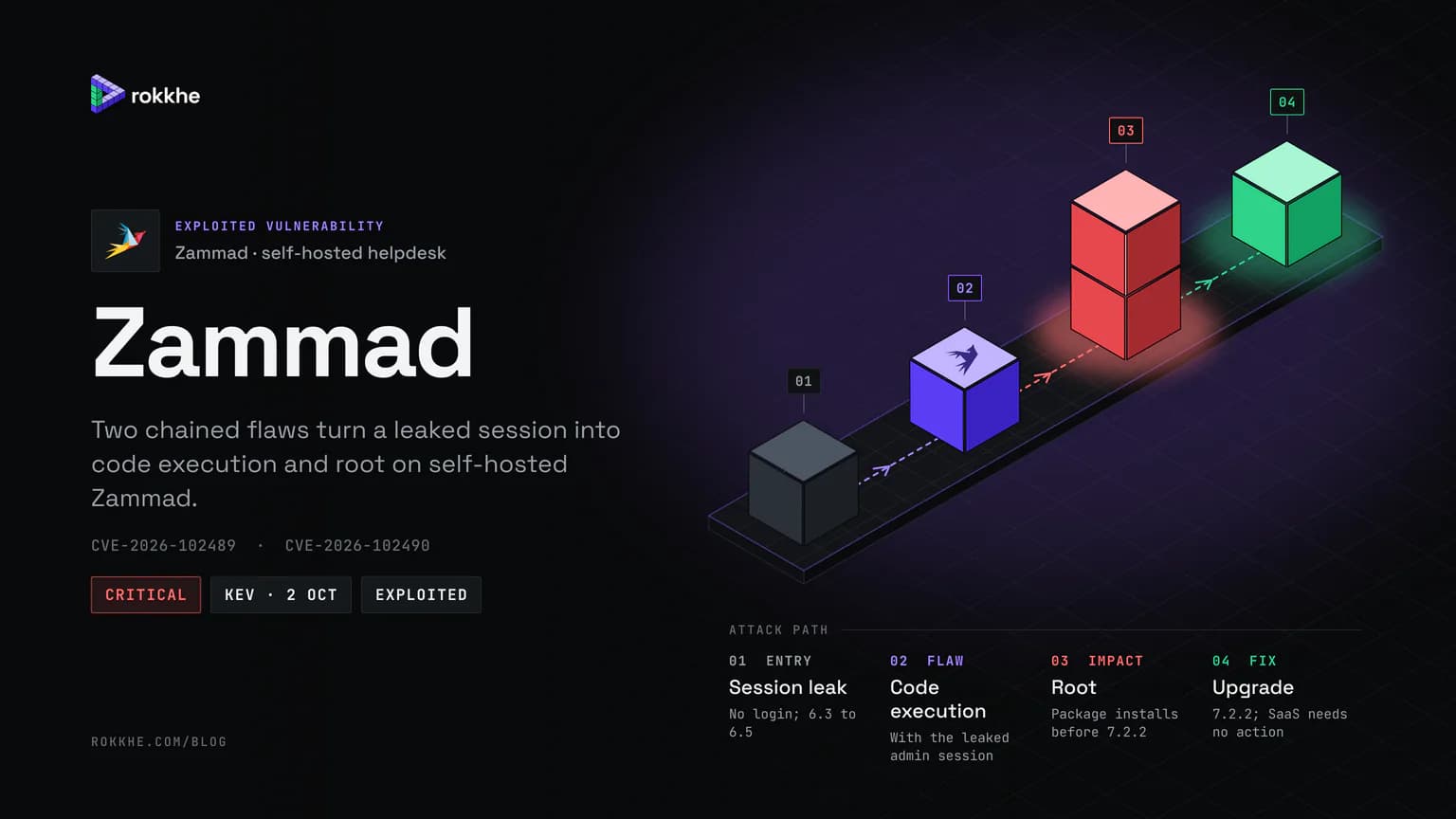
CVE-2026-102489 and CVE-2026-102490 are chained Zammad helpdesk flaws: a session leak in self-hosted 6.3 to 6.5 that leads to code execution, and a root escalation in DEB and RPM packages before 7.2.2. DIVD says both were used to breach its Zammad server on 21 September 2026, and CISA added them to KEV on 2 October. Upgrade to 7.2.2; Zammad SaaS needs no action.
The attack path
Four steps, from the way in to the fix.
Most helpdesk vulnerabilities expose tickets. This pair took an attacker from no account at all to root on the server. CVE-2026-102489 lets an unauthenticated request make Zammad 6.x disclose the session cookies of users who are logged in, and an administrator's session leads to code execution as the zammad service account. CVE-2026-102490 then turns that account into root on hosts installed from Zammad's DEB or RPM packages.
The first known victim was itself a vulnerability disclosure organization. The Dutch Institute for Vulnerability Disclosure (DIVD) says an attacker broke into its Zammad ticket system on 21 September 2026 using both flaws. It reported them to Zammad on 24 September, and the CVE records went public on 30 September. CISA added both to its Known Exploited Vulnerabilities catalog on 2 October with a 5 October deadline. Zammad fixed the root escalation in 7.2.2 on 8 October and shipped an emergency 6.5.5 for the session leak on 15 October.
Who is affected
| Flaw | Affected | Fixed |
|---|---|---|
| CVE-2026-102489, session leak to code execution | Self-hosted 6.3.0 to 6.5.4, package or Docker | 6.5.5 (emergency release), or any 7.x |
| CVE-2026-102489 | 7.0.0 to 7.1.x: code present, not exploitable per DIVD and Zammad | Hardened in 7.2.0 |
| CVE-2026-102490, root escalation | DEB and RPM package installs, 1.5.0 to 7.2.1 | 7.2.2 |
| Both | Zammad SaaS | No action required, per Zammad |
The session leak needs only network access to the Zammad web interface. The root escalation needs a foothold as the zammad account first. Installs from source and the official container images are not affected by it, so a Docker install of 6.5 is exposed to the first bug but not the second.
The records disagree at the edges. CVE-2026-102489's description includes 6.5.4 but its formal range stops before it, and Zammad says only that 6.5 and earlier are exploitable. Early posts put the root flaw at 1.5 to 7.1.0-alpha; the CVE record and Zammad's GitHub advisory now say every packaged release before 7.2.2. Treat 6.5.4 and 7.2.1 as affected.
How the Zammad chain works
CVE-2026-102489: session cookies in an error response
CISA and NVD file this bug as session fixation (CWE-384). DIVD and the researchers at Horizon3 describe it differently: as a leak. Zammad's WebSocket server keeps connection data for every client, including the session cookie, and an error path returned that data to the requester. With a stolen administrator session, an attacker can run code as zammad.
Zammad says the runtime environment of 7.0 and later prevents exploitation. It hardened the affected code in 7.2.0 and hardened the WebSocket server code in 6.5.5. Horizon3 published a working exploit on 7 October.
CVE-2026-102490: root runs files the service account can change
Zammad's packages, built with packager.io, started service processes as root. Before switching to the zammad account, those processes ran files that zammad owned and could modify, and the installation directory was writable by that account too. The services restart automatically when they stop, so an attacker who controls the account can reach root within seconds, with no administrator involved.
Is it being exploited?
Yes. The public evidence comes from one victim and CISA:
- DIVD. Breached on 21 September 2026 through its Zammad instance and detected within 19 minutes; it investigated with Merlon Security. DIVD attributes the activity after root access to AI agents, citing the volume of artifacts and commented attack scripts. That attribution is its own assessment.
- CISA. Both CVEs were added to KEV on 2 October with a 5 October deadline and forensic triage required. Use in ransomware campaigns is listed as unknown.
- Public exploit. Horizon3's code covers CVE-2026-102489 only. It withheld details of the escalation.
We found no other named responder reporting exploitation. Two points are disputed. Zammad says it first received a report of the session issue in August 2026, when 6.5 was already out of support, so the "zero-day" label DIVD uses is contested for that bug. Zammad also objects that the root CVE went public before it received technical details, which arrived on 1 October. The two CVEs appear among the other October 2026 KEV additions.
Check your exposure
Find the install type and version, then search the logs for DIVD's indicator:
# Package installs: the root escalation applies to these
dpkg-query -W zammad 2>/dev/null || rpm -q zammad

# Docker Compose installs: the image tag is the version
docker compose images

# DIVD's indicator: session material in Zammad error output
zgrep -E 'ERROR -- :.*("Cookie"=>"|@clients=\{)' /var/log/zammad/*.log* /var/log/nginx/*.log*
For Docker installs, run the same pattern against the container logs. A hit means session cookies appeared in error output.
Fix it
Upgrade self-hosted installs to 7.2.2 or later. That covers both bugs: 7.x is not exploitable for the session leak, and 7.2.2 fixes the packaging flaw. Zammad's update guide says not to skip major versions, so a 6.5 install moves to 7.0 first and then to the latest release.
Package users may need to switch repositories before the update appears. Zammad now builds packages with a new toolchain, and the old repositories no longer receive updates. Its host upgrade and repository migration guide covers the switch, including the separate stable-6.5 channel that carries 6.5.5.
If you cannot leave 6.5 today, 6.5.5 closes the session leak only; Zammad also advises limiting server access to trusted administrators, and DIVD says to upgrade to version 7 or take the instance offline. Zammad SaaS customers need to do nothing.
Detect attempts and compromise
Published guidance is thin. What exists:
- Session material in errors. DIVD's script flags Zammad and nginx error lines that contain a cookie header value or the server's client registry. Any match means sessions were exposed, whether or not anyone used them.
- Unfamiliar processes and files. DIVD's script says a clean result is not the end of the check and asks you to look for processes and files you do not recognize on the host.
If any of these signals fired, assume the attacker had root and everything Zammad holds: tickets, mailboxes, channel credentials and API tokens. Rebuild the host rather than clean it, end every session, and rotate the credentials stored in Zammad.
Beyond this patch
DIVD was running an out-of-support release. Helpdesks hold mail, secrets and customer data, so they need the same support-lifecycle tracking as anything public, and a service account should never own code that root executes. After you patch, confirm the fix with evidence; how a retest verifies a fix explains the approach Rokkhe takes for findings it has reproduced.
Frequently asked questions
Am I affected if I run Zammad 7?
Not by the session leak. DIVD and Zammad both say CVE-2026-102489 cannot be exploited on 7.0 and later, and Zammad hardened the code in 7.2.0. The root escalation, CVE-2026-102490, affects every DEB and RPM package release before 7.2.2, including 7.x. If you installed Zammad 7 from packages, upgrade to 7.2.2. Installs from source or the official container images are not affected by the escalation.
Is Zammad SaaS affected?
Zammad says its hosted customers need to take no action. The 7.2.2 release notes say SaaS instances are not affected by the packaging flaw behind CVE-2026-102490, and the 6.5.5 notes say no action is required for SaaS customers. The exposure is in self-hosted installs: 6.3 to 6.5 for the session leak, and DEB or RPM package installs before 7.2.2 for the root escalation.
Is there a workaround if I cannot upgrade to 7.2.2?
Only a partial one. Zammad 6.5.5, an emergency release in the out-of-support stable-6.5 package channel, fixes CVE-2026-102489 but its notes do not mention the root escalation. Zammad also advises restricting access to the server to trusted administrators. DIVD's advice is to upgrade to Zammad 7 or take the instance offline. Upgrading through 7.0 to 7.2.2 is the only complete fix.
Are CVE-2026-102489 and CVE-2026-102490 being exploited?
Yes. DIVD says an attacker used both to breach its Zammad ticket system on 21 September 2026, then gained root and continued with activity DIVD attributes to AI agents. CISA added both CVEs to its Known Exploited Vulnerabilities catalog on 2 October 2026, with a 5 October deadline and forensic triage required. Horizon3 published exploit code for the session leak on 7 October.
How do I check whether my Zammad server was compromised?
DIVD published a script that searches Zammad and nginx logs under /var/log for error lines containing session cookies or the WebSocket client registry. Any match means sessions were exposed. DIVD also advises looking for unfamiliar processes and files on the host. If you find signs of compromise, assume root access, rebuild the server, end every session and rotate the credentials Zammad stores.
Sources
- Zammad — Security Advisory: CVE-2026-102489 and CVE-2026-102490
- Zammad security advisory GHSA-p97w-927q-8vxq (CVE-2026-102490)
- Zammad — Release notes for 7.2.2
- Zammad — Release notes for 6.5.5
- Zammad community — Zammad statement on DIVD-2026-00015
- Zammad docs — Host Upgrade and Repository Migration
- Zammad docs — Updating Zammad
- CISA — Adds Two Known Exploited Vulnerabilities to Catalog (2 Oct 2026)
- CISA — Known Exploited Vulnerabilities catalog (JSON feed)
- CVE record — CVE-2026-102489 (DIVD CNA data)
- CVE record — CVE-2026-102490 (DIVD CNA data)
- NVD API — CVE-2026-102489
- NVD API — CVE-2026-102490
- DIVD — Case DIVD-2026-00015: vulnerabilities in Zammad
- DIVD — Case DIVD-2026-00014: the DIVD breach
- DIVD — CVE-2026-102489 log check script
- Horizon3 — Zammad CVE-2026-102489: Session Leak to RCE
Published 28 October 2026 · By the Rokkhe research team